Road Trip With a Toddler: 15 Survival Tips by the Mile
A road trip with a toddler works when you stop optimizing for arrival time and start optimizing for stops. The rule that changes everything: plan on roughly two hours of driving between real breaks, leave at a time that puts the longest stretch inside a nap, and accept that a six-hour drive is now an eight-hour day. Below are fifteen tips organized by where you’ll be when you need them — the driveway, the first two hours, the middle, and the last miserable hour — all tested on two toddlers twenty months apart and a lot of interstate.
Before you pull out of the driveway (tips 1–4)
-
Pick the departure time around one long nap. Two windows work: leave 30 minutes before nap time so the first stretch is quiet, or leave right after breakfast and take the nap as a stop. Leaving at 4pm — into the evening crash, in traffic — is the version everyone regrets. Betteroo’s breakdown of typical wake windows at twelve months is a decent guide to where those windows fall.
-
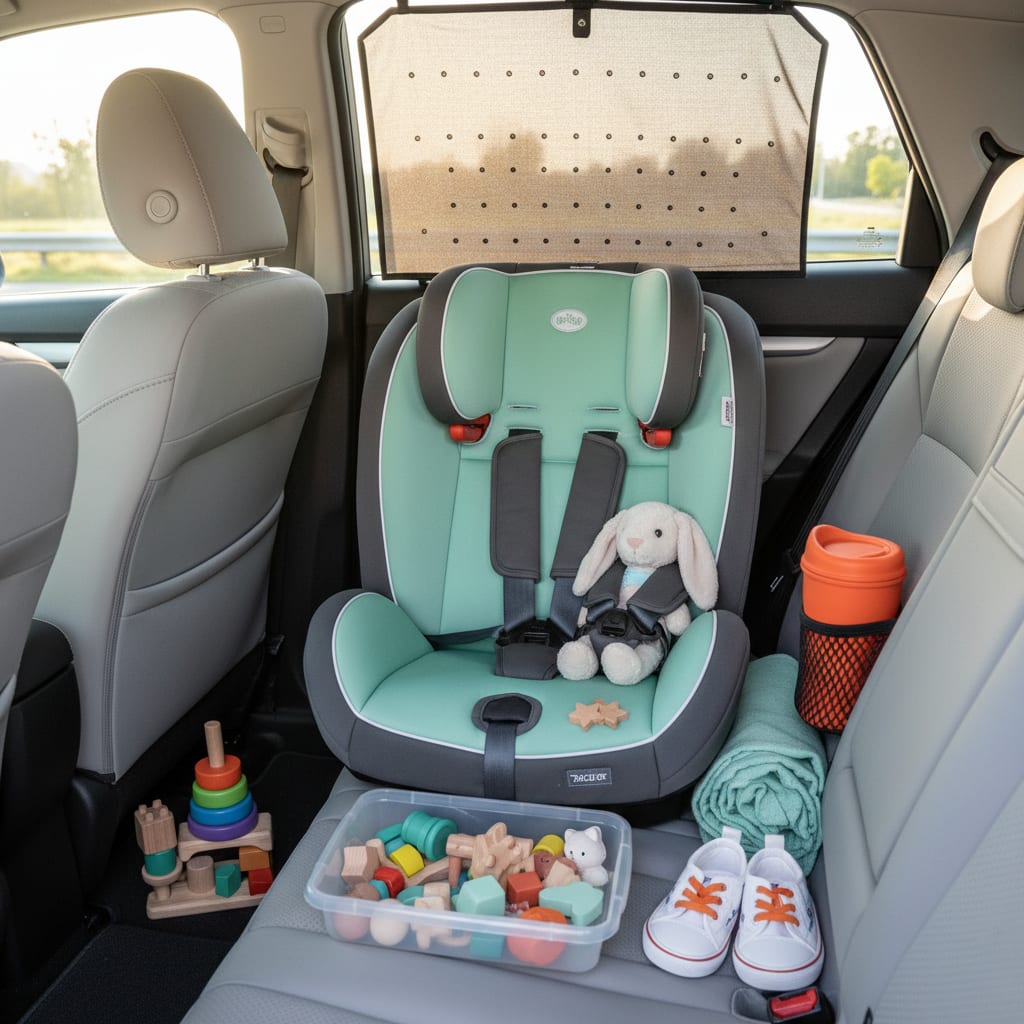
Load the car so the toddler stuff is reachable. Snacks, wipes, a spare shirt and the toy bag go in the front footwell or on the empty back seat — not the trunk. Every item in the trunk costs you a full stop.
-
Do a five-minute run before buckling. Around the yard, up and down the driveway, whatever. A toddler who has moved sits for longer than one who’s been carried from bed to car seat.
-
Check the car seat, then check it again. Straps at the right slot height, chest clip at armpit level, no bulky coat underneath. Long drives are exactly when people get sloppy about this, and it’s the one thing on this list with no acceptable shortcut.
The first two hours (tips 5–8)
-
Don’t open the entertainment yet. The first 45 minutes of a drive are usually free — new scenery, engine noise, novelty. Handing out toys at minute ten wastes them. Start the rotation when the first whine appears, not before.
-
Rotate one item at a time from a front-seat bag. The whole bag in the back seat is gone in eight minutes. One thing, handed back, retrieved, then the next. A pouch of six things run this way lasts two hours; the same six dumped in a lap last one round.
-
Use a spill-contained snack cup rather than open containers. A Munchkin Snack Catcher is the cheap fix for the goldfish-crackers-in-the-car-seat problem, and it means you can hand back a refill without stopping. Dry, low-crumb, non-melting foods only — my two-minute snack ideas list has the car-friendly half.
-
Put a pre-built activity pouch within arm’s reach. Not a toy box — five small quiet things and one item that’s new this week. If you want a repeatable version, my busy bag ideas are exactly the pouch I build the night before a drive.
The middle stretch (tips 9–12)
-
Stop every two hours, and make the stop physical. Not a gas-station stop where everyone stays in the car — a park, a rest area with grass, a fast-food playground. Fifteen minutes of running buys two more hours of sitting. Ten minutes standing next to a pump buys nothing.
-
Carry a travel potty if you’re mid potty-training. The OXO Tot 2-in-1 Go Potty folds flat, works standalone with a liner bag on the roadside and doubles as a seat reducer in a rest-stop bathroom. That single item removes most of the panic from the “I need to go” announcement. My potty training out of the house tips cover the rest of the car kit.
-
Protect the nap fiercely. When they fall asleep, nobody stops, nobody talks loudly, and you don’t pull off for coffee. A car nap is worth an hour of good behavior on the other side, and it’s usually the only nap you’ll get.
-
Sit in the back for the hard hour, if there are two of you. An adult in the back seat can hand things over, play the naming game, and reach a dropped cup — the three problems that otherwise become roadside stops.
The last hour and arrival (tips 13–15)
-
Save one genuinely new thing for the final stretch. A sticker pad they’ve never seen, a small toy from the back of the closet, a cheap gas-station find. Hour five is where a trip goes bad, and the new item is your last card. A reusable sticker pad works well here because the stickers peel off the car seat again.
-
Narrate the countdown in things, not minutes. “Two more songs and we’re there” means something. “Forty minutes” means nothing at this age. Pick markers they can perceive — a bridge, a tunnel, the end of an album.
-
Set up the sleep space before you unpack anything else. Blackout the room, get the sound machine going, put the familiar lovey in the bed. The drive is only half the trip — my tips for toddler sleep away from home are the other half, and they decide whether tomorrow is fun or grim.

FAQ: road trips with a toddler
How long can you drive with a toddler in one stretch?
Plan on about two hours between real breaks, and treat anything past that as borrowed time. Some toddlers will do three if they’re asleep for part of it. The limit isn’t legal, it’s practical — a toddler who has been strapped in for three hours needs a long, physical stop to reset, not a quick one.
Is it better to drive overnight with a toddler?
It works for some families and backfires for others. You get quiet miles, but you also get an exhausted driver and a kid who wakes at 4am in a strange place having already had their night’s sleep. Driving into one long nap in daylight is the lower-risk version of the same idea.
What should I pack in the car for a toddler road trip?
Reachable snacks and a spill-contained cup, wipes, a full change of clothes, a small rotating activity pouch, one brand-new item held in reserve, a travel potty if you’re training, and the sleep gear for the destination. Anything you can’t reach from the front seat may as well be at home.
How do I stop my toddler screaming in the car seat?
Check the boring things first — too hot, straps digging, sun in the eyes, hungry — because those are most of it. Then hand back something new, and if it doesn’t land within a few minutes, stop. A screaming toddler in a moving car is a safety problem for the driver, not just a mood problem.
Should I let my toddler watch a screen on a long drive?
Your call, no judgment. If you use one, hold it back until the last hour or two. Screens are the highest-value card in the deck, and once they’re played, nothing else you brought will register.