Potty Training With Daycare: 8 Tips to Stay in Sync
Potty training with daycare works when both sides run one plan, in the same words, with the same response to accidents — and when you ask the classroom what their system is before you announce yours. Daycare has ratios, nap mats and eleven other toddlers; a plan that ignores that gets quietly abandoned by Wednesday. Below are the 8 tips that kept my two in sync with their room, including the exact sentences I used at drop-off and the kit that stopped the daily bag-of-wet-clothes situation.
Start with their system, not yours
Before anything, ask three questions at pickup: When do you take the class to the bathroom? What do you do when a child has an accident? What do you need from me to start? Most rooms run scheduled group trips — after breakfast, before outside time, before and after nap — which is a genuinely good structure and almost certainly more consistent than your house. Fit your home plan around theirs where you can. It’s much easier to add two prompts at home than to get a classroom to run a bespoke schedule for one kid.
Also ask what their policy actually requires. Some programs won’t move a child out of pull-ups until they’re initiating; some can’t rinse soiled clothes for health-code reasons; some need a written note to start. None of that is unreasonable — it’s just information you’d rather have before day one than at day three.
The 8 tips
- Pick a start date with the room, not for it. Avoid the week of a classroom transition, a new teacher, a room move, or your family vacation. Tell them your target date and ask if it’s a bad week — they’ll know things you don’t. Then start on a Monday after a weekend of home practice so day one at daycare isn’t also day one, period.
- Write a one-page plan and hand it over. Not a manifesto. Half a page: the words you use (“pee,” “poop,” “potty”), your prompt phrasing, whether they wipe alone, what they wear, your accident script, whether you’re using rewards and what kind. A teacher who has your exact wording can be consistent at 11am without guessing. If you’re using incentives at home, say so and keep them modest — my potty reward ideas list ones that travel between houses and classrooms without escalating.
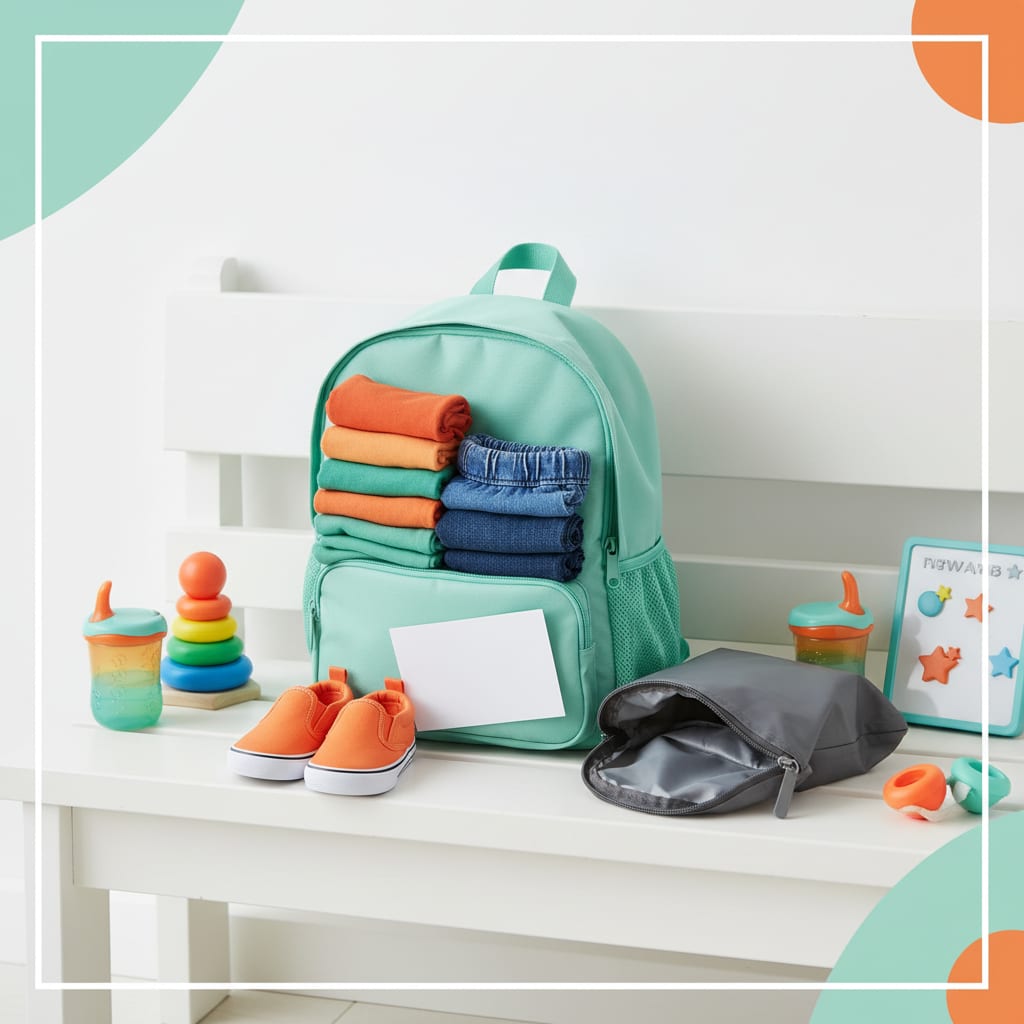
- Dress for a stranger’s speed. Elastic waists only. No overalls, no buttons, no belts, no onesies, no tights, no romper with snaps at the crotch — a teacher with eight kids cannot excavate your child from a jumpsuit in the four seconds you actually get. Shoes that come off easily help too, because wet socks are a whole separate errand.
- Overpack, then overpack again. Five changes of everything: underwear, pants, socks, a shirt (accidents travel upward more than seems fair). Label it all. Restock the bin the same evening it thins out, not “tomorrow” — the day the bin is empty is the day a teacher puts your kid in the borrow-bin sweatpants and you’re the one who feels bad.
- Send a proper wet bag. Two, actually: one for the daycare bin and one for the trip home. A zippered waterproof wet bag keeps soaked clothes from marinating your kid’s whole backpack, and it makes the handover at pickup a two-second transaction instead of a plastic-grocery-bag apology tour.
- Agree on one accident script and use it in both buildings. Something flat and short: “Pee goes in the potty. Let’s get dry clothes.” No sighing, no “again?”, no consequences. Then genuinely mean it at pickup — if a teacher hands you three wet bags and you visibly deflate, your kid reads that instantly and the hiding starts.
- Treat nap and pull-ups as a separate project. Nap-time accidents on a mat are normal for months after daytime is solid, and daycare naps are notoriously hit-or-miss anyway; the range for when kids drop the nap is wide enough that your kid may be lying awake for an hour with nothing to do but hold. A pull-up for nap only, taken off immediately after, is a reasonable compromise most rooms are happy with — just call it a “nap pull-up” out loud so it doesn’t read as a demotion.
- Ask for a two-line daily readback for the first two weeks. Not a spreadsheet: how many successes, how many accidents, roughly when. Two weeks of that tells you whether the accidents cluster before outside time or after nap, which is the difference between “add a prompt at 10:45” and “we have a problem.” Most rooms already log it; you just have to ask to see it.
When home and daycare disagree
It happens. The room says your child is nowhere near ready; you’ve had a dry week at home. Or they’ve been trained at daycare for a fortnight and go feral on Saturdays. Both are normal — kids are excellent at running different rules in different buildings, and a room full of peers using the potty is a motivator no parent can replicate at home.
Handle it as information, not a verdict. Ask what they’re seeing specifically (holding? refusing to join the group trip? accidents only during free play?), then match it. If daycare is ahead, ask what they’re doing and copy it exactly. If home is ahead, offer your script and ask them to run it for a week before deciding.
The one thing not to do is add pressure to close the gap. A kid getting prompted hard at home and nudged at daycare has no low-stakes place left, and that’s how you get holding and a slide backwards. If things do slide, my potty training regression fixes work the same way whether the trigger was a new classroom or a new sibling. And the out-of-house half — bathrooms in strange buildings, field trips, the car — is covered in my potty training out of the house tips.
FAQ: potty training with daycare
Should I start potty training at home first or at daycare?
Do a few consistent days at home first — a long weekend is plenty — so your child arrives at daycare with the basic idea and the vocabulary. Then start the classroom on a normal week. Starting in both places on the same morning gives you two sets of new rules at once, which is a lot for a two-year-old.
What if daycare won’t potty train my toddler?
Most won’t refuse outright, but many have a policy threshold — often that the child asks to go, or stays dry for a set stretch. Ask exactly what the threshold is and what evidence they need. Meanwhile, keep going at home; kids routinely cross that line at home first and daycare follows within a week or two.
Should my toddler wear pull-ups at daycare?
Underwear during the day once you’ve committed, because pull-ups feel like diapers and muddy the message. Nap is the sensible exception — a nap-only pull-up, removed as soon as they’re up, avoids soaked mats without confusing the daytime rule. Follow the room’s policy where they have one.
My toddler is dry at daycare but has accidents at home. Why?
Usually structure. Daycare runs scheduled bathroom trips and a room full of peers doing the same thing; home is looser and more interesting. Add prompts at your natural hinge points — after waking, before leaving, before meals, before bed — and keep the response to accidents flat and boring.