Toddler Climbing Out of the Crib? 11 Tips That Help
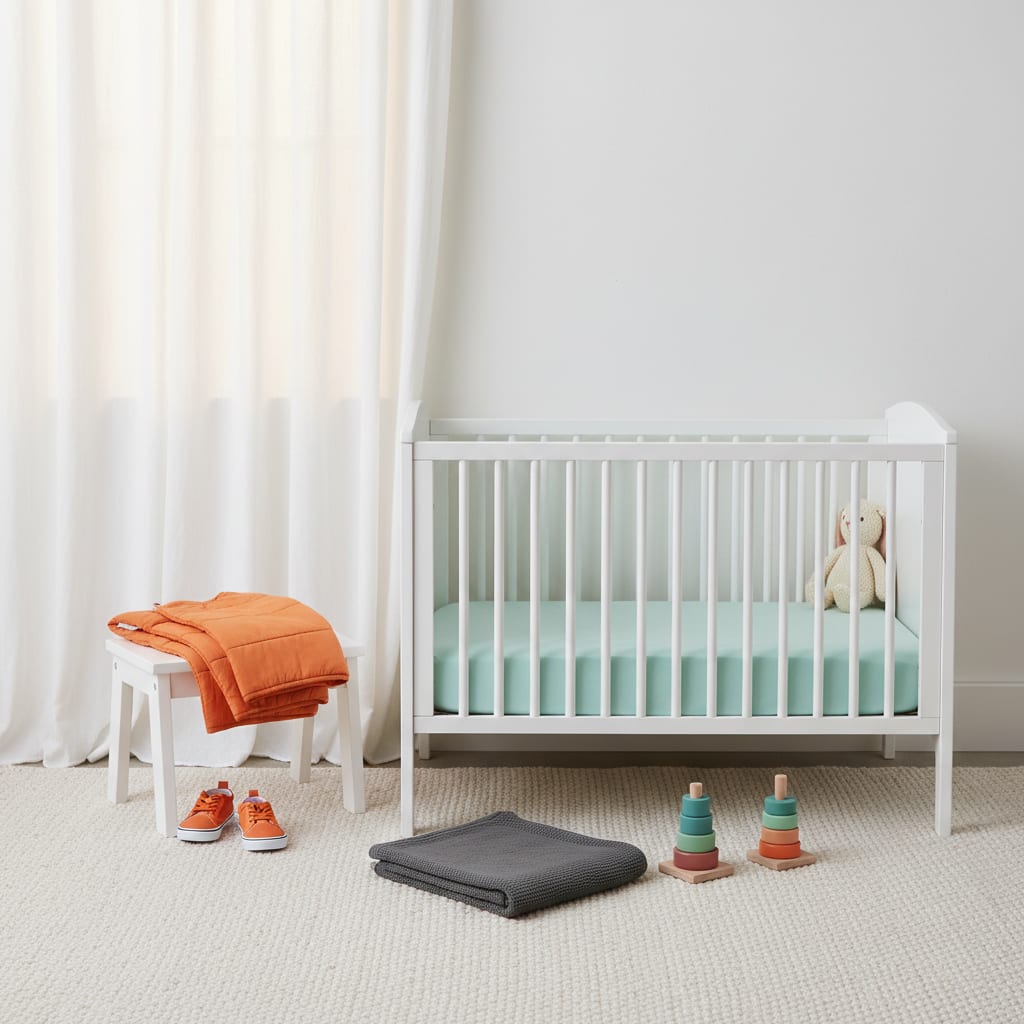
Two things end most crib-climbing careers, and you can do both tonight: drop the mattress to its lowest setting and put your toddler in a sleep sack that fits at the hips. Between them they remove the step and the leg swing every climb needs. If a determined toddler still gets over the rail after that, the crib has stopped being the safe option and the room becomes the container instead. Below are eleven tips in the order I’d actually run them — three for tonight, three that buy weeks, three for the daytime, two for once the crib has lost. My oldest never tried it; my youngest was over the rail at nineteen months, and everything here came out of that fortnight.
Do these three tonight (tips 1–3)
-
Take the mattress all the way down. Not one notch — all the way. If yours has been on a middle height since the newborn days, this single change ends it for a lot of toddlers, because the rail suddenly sits at armpit height instead of hip height. Takes ten minutes and a screwdriver.
-
Empty the crib down to a sheet and one lovey. Bumpers, wedges, folded blankets, the big plush dog from grandma — anything with structure is a step stool, and a toddler will find that out before you do. Fitted sheet, one small comfort item, nothing else in there.
-
Turn the crib and clear the landing zone. If one side sits lower, face it into the wall, and move the dresser, toy bin and chair out of reach — a climber who can’t get over the rail will happily reach across to something. Then clear anything hard-edged off the floor around the crib. Tips 1 and 2 are about not falling; this one is about the fall you didn’t prevent.
For the full safety decision tree — what counts as an emergency, why crib tents and DIY lids are a hard no, and when a bed becomes the safer choice — my sister site’s explainer on a toddler climbing out of the crib does the whole why. This post is the what to do.
Buy-time tricks that hold for weeks (tips 4–6)
-
Put them in a proper toddler sleep sack. This is the highest-value item on the list after the mattress drop. A sack that fits at the hips physically stops the leg going over the rail — they can pull up and then have nowhere to put the foot. Size it for the hip fit, not the height. The HALO Sleepsack Toddler is the plain, widely-used version, and Betteroo’s rundown of what to look for in a toddler sleep bag covers TOG and sizing.
-
Turn the sack backward if they’ve learned the zipper. They will learn the zipper. Wearing it back-to-front is the standard workaround, it’s safe, and it bought me about six extra weeks. Check the neck still sits comfortably and that they can get their arms out normally.
-
Be the dullest person alive when you put them back. A gasp, a laugh, a story you retell to your partner in front of them — all of it is a five-star review, and toddlers rerun their best material. Lift them back in, say the same four words (“you stay in your crib”), and leave. No negotiation, no second story. It feels like it isn’t working for about four nights, and then it usually is.
Send the climbing somewhere else in daylight (tips 7–9)
Here’s the part most crib-climbing advice skips: the climbing isn’t a bedtime problem your toddler invented at 7pm. It’s a stage they’re in for about six months, and it comes out wherever there’s a surface. If the only place they’re allowed to climb is off-limits, the crib gets all of it.
-
Build a legal climbing thing indoors. Sofa cushions stacked into a mountain with the seat cushions on the floor as a crash pad costs nothing and takes ninety seconds. If you want something sturdier for a long winter, a toddler climbing triangle like the Little Partners Learn ‘N Climb folds flat between uses. Either way, the rule that matters is that somewhere is a yes.
-
Spend the climb before bath, not after dinner. Playground ladders, stairs on purpose (up on hands and knees, down on their bottom, with you right there), climbing on and off the bottom step twenty times because they want to. Fifteen minutes of real climbing in the hour before the wind-down does more than any amount of bedtime negotiating. If your evenings are already a fight, my bedtime routine checklist is the order I run.
-
Check whether they’re going in under-tired. The classic climber is a toddler put down with energy left to spend, and engineering is what they spend it on. A nap that ran to 4pm, or a bedtime moved earlier because of the escaping, both produce exactly that surplus. If naps are the moving part, my nap-refusal tips cover what to try before you drop it — and nap-time climbing usually starts before night-time climbing, so it’s the early warning.
Once the crib has lost (tips 10–11)
A toddler who beats the lowest mattress, the empty crib and the sleep sack has won fairly. Continuing the arms race is less safe than conceding, and conceding early is not a parenting failure — it’s the correct read.
-
Move the sleeping surface down, not the standards up. Crib mattress on the floor is a completely legitimate week-one answer, and honestly it’s what we did. It removes the fall entirely while you get the room sorted and the actual bed organised. My 12 tips for the toddler bed switch cover the setup, and the room-proofing that has to happen first is spelled out in the toddler-proof bedroom guide for a climber.
-
Expect them to use the freedom, and have the return ready before night one. A nineteen-month-old cannot hold a rule like “stay in bed” the way a three-year-old can, so the plan can’t rely on them remembering it — it relies on you walking them back the same boring way forty times. Load the stay-in-bed playbook before the first night, not during the third, and put a gate at the doorway so the contained space is the room.
What the fortnight actually looks like
Nights three to five are usually the worst, not night one — the novelty wears off and the testing begins. Change one thing at a time and give it two weeks before you judge it. Both adults have to run the same script, too: one parent doing the silent return while the other brings them out to the sofa keeps the phase alive indefinitely.
Any fall with a head impact, vomiting, unusual drowsiness or anything at all that worries you is a same-day call to your pediatrician, not a next-visit mention.

FAQ: the toddler who climbs out
How do I stop my toddler climbing out of the crib?
Drop the mattress to its lowest setting, strip the crib to a sheet and one lovey, move furniture away from the rails, and use a well-fitted sleep sack. That combination ends most climbing. Keep your reaction flat and identical every time, because attention funds a second attempt.
Does climbing out mean my toddler is ready for a bed?
No — it means they’re ready to climb. The toddler scaling the rails at twenty months is usually showing you less impulse control, not more. Contain safely first; move to a bed only when containment genuinely fails.
What age do toddlers start climbing out of the crib?
Most commonly somewhere between about 18 months and two and a half, though some go earlier and plenty never try at all. It tracks physical confidence rather than age, which is why one sibling does it and the next doesn’t.
Can I use a crib tent to keep them in?
No. Tents, nets and improvised lids introduce entrapment risk that’s worse than the climbing, and crib tents have been recalled in the past. If the crib needs a roof, the crib phase is finished.
They climbed out once and haven’t since — do I still need to change things?
Yes, run tips 1–3 anyway. One successful climb proves the capability exists, and you don’t want the second attempt to be the one you weren’t set up for.