Toddler Nosebleeds at Night? 10 Tips for the 2am Mess

Sit them up, tip the head slightly forward, pinch the soft part of the nose and hold it without letting go. Do not lie them down and do not tilt the head back. Then go after the cause, which in a heated bedroom in winter is almost always dry air. Ten tips below for the night side of this — the moment itself, getting a frightened toddler back to sleep, and the point where it becomes a call to your pediatrician. I am not a clinician and none of this replaces one.
What is actually happening
The American Academy of Pediatrics is reassuring about the base rate: “Your child is almost certain to have at least one nosebleed — and probably many — during their early years. Some preschoolers have several a week. This is neither abnormal nor dangerous, but it can be very frightening.” Nemours KidsHealth names the cause you can do something about: “Most anterior nosebleeds in kids are caused by nose-picking or dry air. A dry climate, heated indoor air, or dehydration can potentially lead to nosebleeds by irritating or drying out nasal membranes.”
That is why these cluster at night and in winter. The furnace runs, the membranes dry and crust, the crust itches, a sleeping toddler rubs at it, and you get woken at 2am.
In the moment (1–4)
- Get the light on and yourself calm first. The AAP’s first instruction is “remain calm,” for a practical reason: a panicking adult produces a panicking child, and a panicking child will not hold still for ten minutes of pressure. Keep their line on volume in your head — “the blood coming from the nose always looks like a lot.”
- Sit up, lean slightly forward. KidsHealth: “Have your child sit upright in a chair or on your lap or stand with the head tilted slightly forward. Do not have your child lean back. This may cause blood to flow down the back of the throat, which tastes bad and may cause gagging, coughing, or vomiting.” Head-back is the thing families most often get wrong at 2am.
- Pinch the soft part, and do not peek. Not the bony bridge — the fleshy lower half, “just below the bony center part of the nose,” held firmly. The AAP: “Don’t release the nose during this time to see if it is still bleeding (no peeking)! Stopping the pressure may interfere with the forming of the clot.” The sources give different clock times — the AAP says at least 10 minutes then reassess, KidsHealth about 15 — so set the longer one and count it properly.
- Do not pack anything up the nose. The AAP: “Don’t stuff tissues, gauze, or any other material into your child’s nose to try to stop the bleeding.” Catch what comes out with a cloth; do not push anything in.
Getting them back to sleep (5–6)
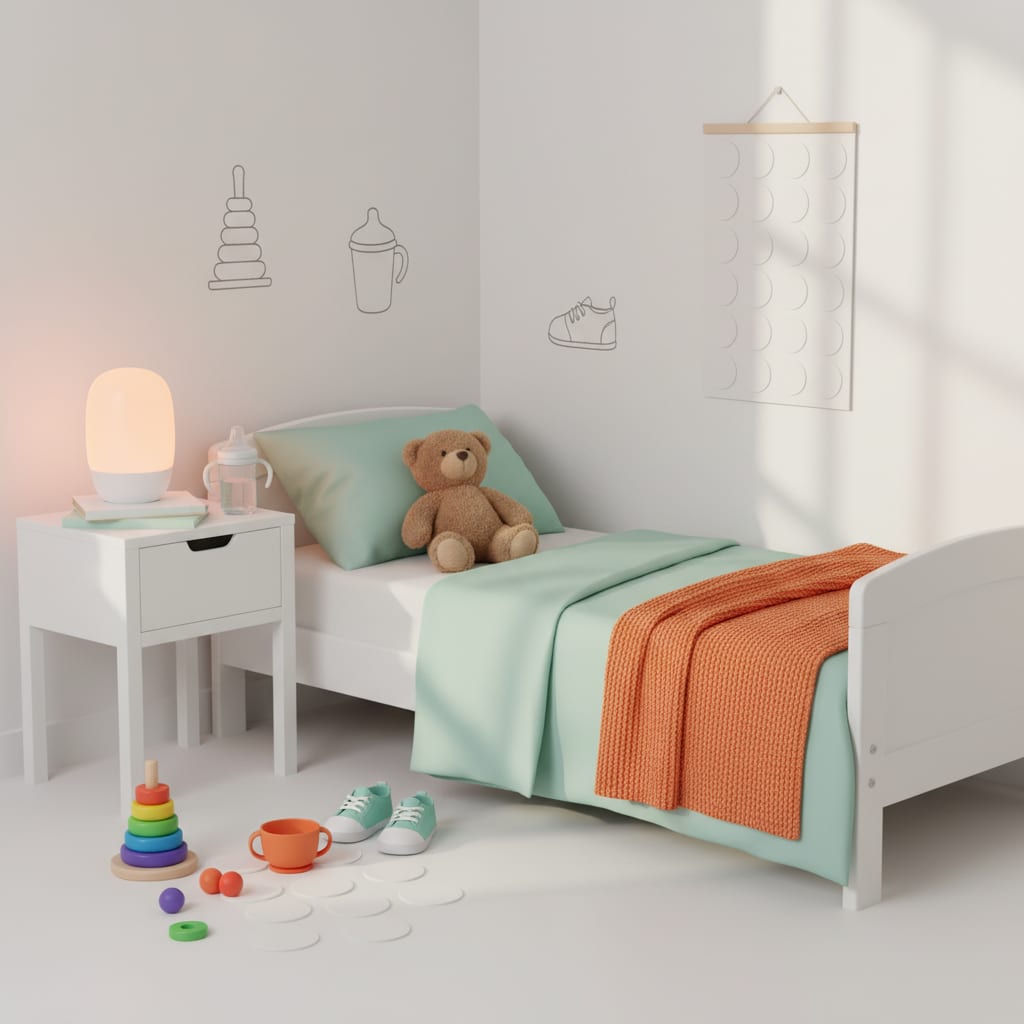
- Change the pillowcase, not the whole bed. A dark stain on white cotton is the thing a three-year-old will stare at and ask about for twenty minutes. Keep a spare pillowcase and fitted sheet in the room so a 2am change takes ninety seconds. Darker bedding in winter genuinely helps — one more reason what you put on a toddler’s bed matters.
- Give them the boring version of the story the next day. “Your nose gets dry and a tiny bit of it bleeds, and then it stops.” Once, in daylight, in flat language — a toddler with no explanation supplies their own, and theirs is worse. Then go back to the normal bedtime routine without adding a nosebleed check to it, because a new checking step is how a one-off becomes a bedtime anxiety.
Stop the next one (7–9)
- Fix the air before anything else. Both sources point at the same first move: run a cool-mist humidifier in the bedroom if your home is dry. KidsHealth adds the part people forget — “keep the machine clean to prevent mildew buildup.” The EPA sets the ceiling you are aiming under: “Indoor relative humidity (RH) should be kept below 60 percent — ideally between 30 percent and 50 percent, if possible.” It is a range, not a more-is-better dial. A cheap hygrometer tells you whether you have a problem at all, and a plain evaporative unit like the Honeywell HCM350 is easy to take apart and clean.
- Turn the heat down and aim the vent away from the bed. A radiator or a duct blowing across a pillow is a hairdryer pointed at a small set of nasal membranes for eleven hours. Moving the bed a foot, or closing a vent partway, is free. Betteroo’s rundown on how warm a bedroom actually needs to be is the useful reference, because most of us heat children’s rooms more than we need to.
- Cut their nails on Sunday nights. KidsHealth’s prevention list opens with it: “Trim your child’s nails to prevent injuries from nose-picking.” Thirty seconds, and it removes the mechanism.
10. The petroleum jelly question — ask your pediatrician
This is the one thing on the list I will not tell you to do, because the two sources above disagree and the disagreement is about bedtime specifically.
The AAP: “If your child gets a lot of nosebleeds, ask your pediatrician about using saltwater (saline) nose drops every day and/or putting a small amount of petroleum jelly in each nostril at night,” particularly “when the furnace is on.” KidsHealth: “It’s OK to use a small amount of petroleum jelly on the nostrils, but avoid using it too often and avoid using just before bedtime. If swallowed, over time it can cause a rare but serious type of pneumonia.”
Both are mainstream pediatric sources talking about the same bedtime you are asking about. Note the AAP’s own wording is “ask your pediatrician” rather than “do this” — so that is the answer. Ask, say you were planning to use it at night, and let someone who knows your child decide. Saline drops and water-based nasal gel appear in both and are less contested.

When it stops being a night problem
Two thresholds, both worth knowing. KidsHealth: call your doctor “if your child gets nosebleeds more than once a week,” or if bleeding “doesn’t stop after two attempts of applying pressure for 15 minutes each,” or if your child bruises easily, bleeds heavily from minor wounds or the gums, recently started a new medicine, or may have put something in their nose. The AAP’s referral line is “more than 5 nosebleeds a year, or the bleeding typically lasts more than 10 minutes.”
Get emergency care, per KidsHealth, if the nosebleed “is heavy or gushing,” comes with “chest pain, dizziness, weakness, or passing out,” follows “a fall or blow to the head,” or is making breathing hard. The AAP adds: call immediately if your child is unusually pale or sweaty, or if blood is coming only from the mouth.
If this started alongside a cold, the night is a different shape — sleep when a toddler is ill covers the rest, and Betteroo’s guide to nights during an illness is a fair companion.
FAQ: night nosebleeds in toddlers
Why does my toddler only get nosebleeds at night?
Usually because that is when they spend eleven hours in heated, dry air and then rub at a crusted, itchy nose in their sleep. The bedroom supplies both the conditions and the opportunity.
Is a nosebleed in the night dangerous?
Ordinary ones are not, and the AAP says so plainly: common, “neither abnormal nor dangerous,” and much more alarming to look at than they are. What needs a doctor is frequency, duration, bleeding elsewhere, or the emergency signs listed above — not one messy pillowcase.
Does a humidifier actually stop them?
It is the intervention both sources reach for first, so it is worth trying — but measure the room rather than guessing, because the EPA’s target range tops out at 50 percent. If the air is already in that band, the cause is more likely picking or a cold, and the nail trim will do more than another appliance.
My toddler panics at the sight of blood. What helps?
Deal with the nose first and the feelings second — pressure, quiet voice, no discussion during the ten minutes. Then let them help with the cloth afterwards, which gives them a job. If the fear outlasts the event by days, the settling tools in getting a toddler through the night are the next step.