Toddler Won't Nap at Daycare? 9 Things That Help

Start with the bedtime at home, not with the mat at daycare. You control one of those and not the other, and a toddler who naps badly on a mat can still be fine overall if the night is doing the work. Then pick off the three things the room will actually change for you: the comfort object, where the mat sits, and the order of the wind-down. Nine things that help below, written for the constraint you are actually under — a lit room, fifteen other children, and a schedule you did not set.
Why the home advice does not transfer
Everything in nap refusal at home assumes you own the room. You can black it out, move the nap thirty minutes, run white noise and try again tomorrow. At daycare the nap happens on a mat, in a room with the lights on low at best, at a fixed time, with a caregiver who has fourteen other children to settle. Almost none of the usual levers exist.
What does still apply is the arithmetic. Nemours KidsHealth puts toddler sleep need at “11–14 hours” a day across nights and naps for ages one to two, and notes that “young toddlers may still take two naps, but most drop down to one nap a day by 18 months.” If the mat nap is short or absent, those hours have to come from somewhere, and the only somewhere you control is the night.
The three things the room will change (1–3)
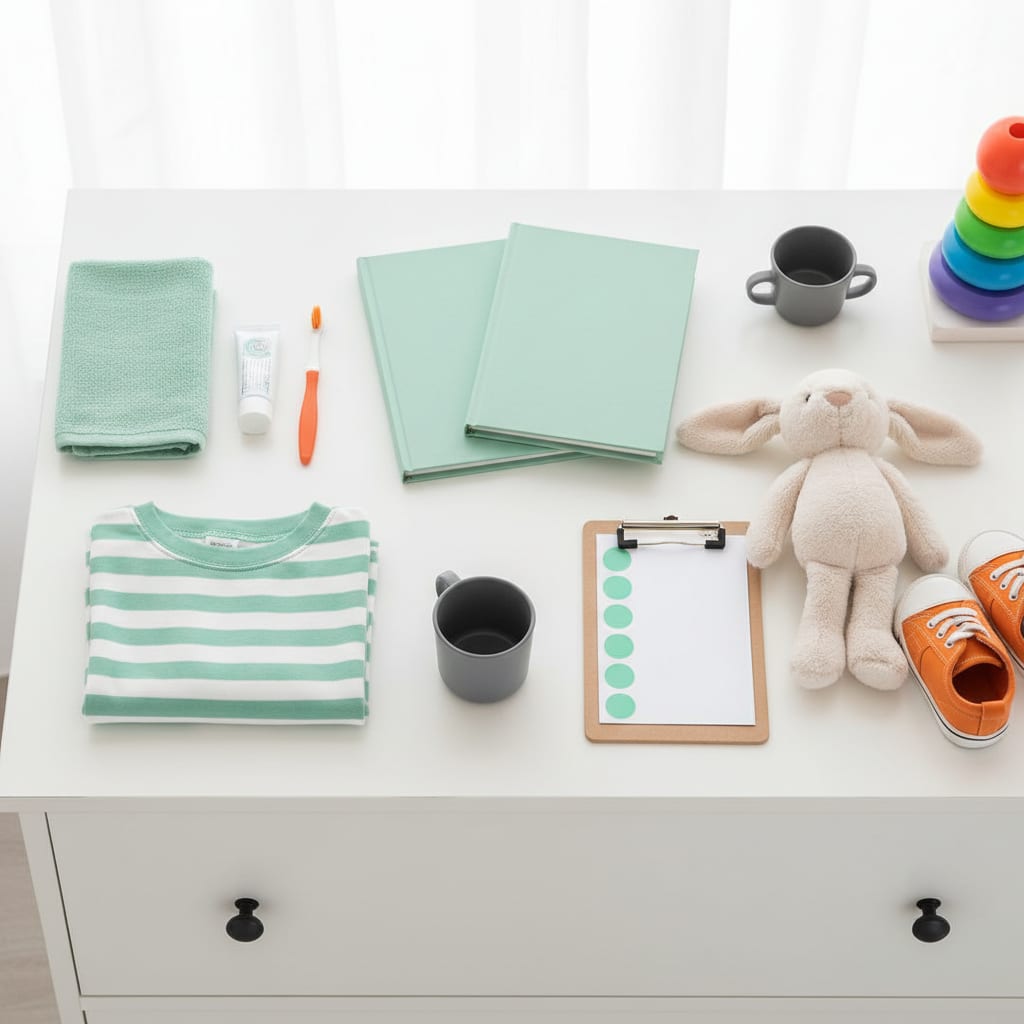
- Get the comfort object onto the mat, in writing. Most centres allow one small soft item at rest time even where the general policy is no toys from home; many parents never ask. Ask specifically — “may she have this one small bunny only at rest time” — rather than generally, because a specific request is easy for a room lead to say yes to and a general one is easy to refuse. Send a duplicate that lives in the bag so it never gets left behind.
- Ask where their mat is in the room. Mat position is the single biggest thing a centre can change for free. Next to the door, next to the sink, or opposite the window are all bad draws, and a child who is the last one settled often gets whatever space is left. A corner spot with a wall on one side is worth asking for by name.
- Ask what the last five minutes look like, then copy them at home. If the room does lights down, then a story, then back rubs, run that same order at home at the weekend. It costs nothing and it means the sequence itself becomes the cue, so the mat is not the only place that sequence happens. This is the same script-swapping move that makes daycare potty training work: match the two settings rather than arguing about which is right.
The conversation with the room lead (4–5)
- Ask for data before you ask for changes. “Can you tell me roughly what time she goes down and how long she’s actually sleeping, for a week?” A room lead can answer that in thirty seconds a day, and it turns “she won’t nap” into something you can act on. Half the time the answer is that she is sleeping forty minutes and you had assumed zero.
- Ask one question, not five. Pick the single change that matters most this month — usually the mat position or the comfort object — and ask for that. A list of requests at pickup, delivered to a caregiver mid-handover, tends to produce polite agreement and no change. One request, in the morning, to the person who actually runs rest time.
What you do at home (6–9)
- Move bedtime earlier on the days the nap fails, not on all of them. Thirty to forty-five minutes earlier is usually enough, and it should track the actual day rather than becoming a permanent new bedtime. KidsHealth’s version of this is blunt: “If your child gives up daytime naps, consider setting an earlier bedtime.” Ask the room to tell you at pickup whether it was a nap day, and use that.
- Do not let the car nap eat the night. The 4:50pm ten minutes in the car seat on the way home is the one that costs you a 7:30 bedtime. Open a window, hand back a snack, take the route with more to look at. This is the highest-value ten minutes of your day and it is almost entirely within your control.
- Protect weekends as catch-up, not as a new schedule. Let the home nap run long on Saturday and Sunday; do not conclude from two good weekend naps that the centre is doing it wrong. And keep the bedtime steady even when the weekend naps go well, because a drifting weekend bedtime shows up as a worse Monday — the bit families find hardest to believe until they watch it happen twice. The bedtime routine checklist is the mechanism for holding that line.
- Accept quiet time as the real outcome for some kids. KidsHealth is realistic about it: “Don’t let naptime become a battle — you can’t force your child to sleep. If your child won’t nap, set aside some quiet time.” A toddler who lies on a mat with a book for forty minutes is getting something, even if the centre logs it as no sleep, and the centre will usually accept “she rests, she doesn’t have to sleep” as a goal more readily than they will accept a sleep target.
 Is the daycare nap slot wrong for their age?
A fixed 12:30 rest time suits some ages and fights others. Betteroo checks the timing against your toddler's age in about two minutes.
Take the 2-minute sleep quiz →
Is the daycare nap slot wrong for their age?
A fixed 12:30 rest time suits some ages and fights others. Betteroo checks the timing against your toddler's age in about two minutes.
Take the 2-minute sleep quiz →
When it is the schedule, not the child
Centres run one rest period for a whole room, and a room can span twelve months of development. A fifteen-month-old on a two-nap body and a two-year-old on one nap are both being asked to sleep at 12:30. If your child is at the young end of the room, the slot may simply be late for them; at the old end, it may be early enough that they are not tired. Betteroo’s rundown of what the daytime numbers usually look like is a fair way to work out which of those you have before you raise it.
FAQ: the toddler who won’t sleep at daycare
Is it normal for a toddler to nap at home but not at daycare?
Very. A lit room, mats a metre apart and fourteen other bodies is a genuinely harder place to fall asleep than a dark bedroom, and plenty of toddlers who nap beautifully at home give the centre twenty minutes and nothing more. It is a setting difference before it is a sleep problem.
Should I ask them to wake my toddler after a certain time?
Reasonable, and most centres will do it — a cap of 3:00pm is a common ask. Do it if late naps are visibly wrecking your bedtime; do not do it reflexively, because a child who is already short on day sleep does not need less of it.
Will they nap better once they settle in?
Often yes, and the timescale is longer than people expect — several weeks, not several days, and it usually goes backwards again after a holiday or an illness. If it is week six and nothing has moved, that is the point to ask for the mat change rather than waiting it out further.
My toddler naps at daycare and then won’t go to bed. What do I do?
That is the opposite problem and a much easier one: ask for the wake-by cap in the answer above, and hold the bedtime steady rather than pushing it later. If they are also up at dawn, the early-waking fixes are the right place to start.