Potty Rewards That Work: 12 Ideas Beyond Stickers
The potty rewards that actually work are tiny, instant, and handed over at the potty — not saved for a Friday prize, not sized like a birthday. A toddler’s memory for cause and effect is short, so a reward two hours later teaches nothing except that Friday is fun. Below are the 12 rewards I’ve actually used across two kids, ordered roughly from cheapest to most elaborate, plus the part nobody writes about: how to retire them before the chart becomes the thing your kid is training for.
The three rules that make any reward work
One: instant beats big. Given within about ten seconds of the win, a single dry bean in a jar outperforms a toy promised for the weekend. Two: name the behavior, not the kid. “You felt it coming and you stopped playing” teaches something; “good girl” teaches nothing repeatable. Three: reward the trying, early on. Sitting, telling you afterward, helping mop up — those are the steps that lead to the real thing. Rewarding only bullseyes makes a kid who won’t sit at all.
And one anti-rule: keep it small enough that you can do it forty times a week without resentment or a second mortgage. If the reward costs you anything to hand over, you’ll start rationing it, and inconsistent rewards are worse than none.
The 12 ideas
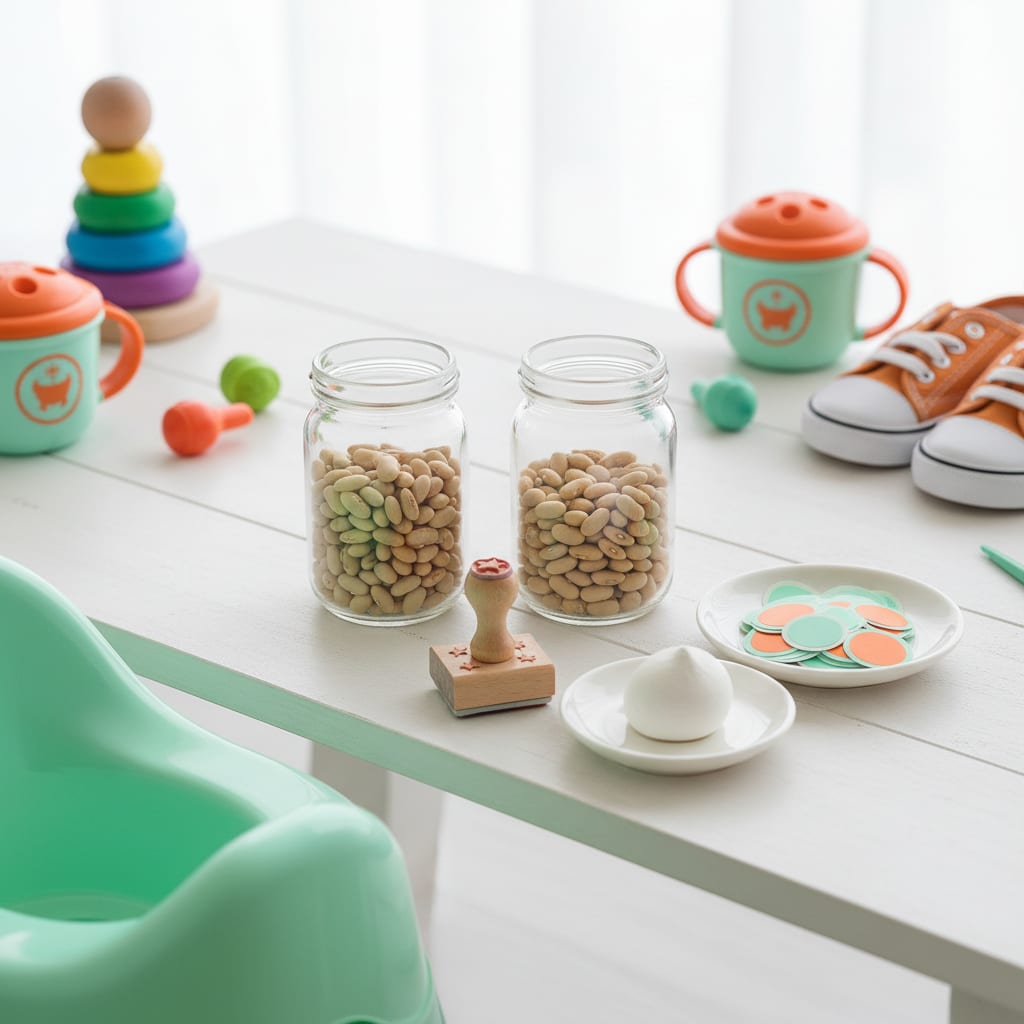
- The transfer jar. Two jars, a scoop of dried beans, pom-poms or pasta shells. One bean moves from jar A to jar B per success, and the kid moves it. The moving is the reward — the jar filling up is a bonus. Cheapest thing on this list, and the one that lasted longest at my house.
- A one-song dance party. Thirty seconds of a specific silly song, same one every time, started before they’ve even got their pants up. Free, portable, and it turns the bathroom into the place where the fun happens.
- The phone call. Grandma, an aunt, a neighbor — anyone reliably available and reliably delighted. Ninety seconds of “you did WHAT?” is a bigger reward than anything you can buy, and it recruits your village.
- Pick the next thing. The win buys a choice: which book, which snack plate, which song in the car, who gets to press the elevator button. Toddlers are power-hungry, and choice is the currency they actually want.
- A stamp on the hand. Self-inking stamps live in a drawer for years. The stamp is visible all day, which means every adult who sees it asks about it, which means the reward keeps paying out.
- The victory sticker — upgraded. If stickers are working, don’t fight it, just make them better. A reusable sticker pad turns each win into “add one thing to the scene” instead of a dot on a grid — same effort, more play, and it survives being peeled at a hundred times.
- Two minutes of the good toy. Something genuinely coveted that lives on a high shelf: the magnet tiles, the water beads, the sibling’s cars. A short, timed turn right after a success beats a whole new toy nobody remembers by Thursday.
- Job promotion. “Potty people get to carry the eggs.” Real, slightly-too-grown-up responsibilities land beautifully at this age — pressing the washing machine button, dumping the dustpan, holding the keys to the door.
- The flush ceremony. Some kids find flushing terrifying; others find it the entire point. If yours is the second kind, make it big — wave goodbye, narrate the journey, do the whole bit. Free reward, delivered inside the routine, no props.
- A tiny treat, delivered honestly. One mini marshmallow, half a cracker, two raisins. It works, it’s fine, and food rewards at this scale won’t ruin anybody — but keep the portion comic-book small and don’t let the treat become the only reward on the menu, or you’ll be negotiating with a small mercenary by week three. If your kid already treats food as leverage, skip this one entirely and use number 4 instead.
- The five-minute unlock. The reward isn’t an object, it’s your undivided attention: five minutes of floor time, their game, phone in another room. Expensive in minutes, cheap in everything else, and the most reliably motivating item on this list.
- The graduation prize (once). One real, chosen-in-advance prize for the milestone — big-kid underwear they picked, a trip to feed the ducks, the fire truck they’ve been petitioning for. One time, at the end, clearly framed as a finish line. Not weekly. Weekly turns into salary, and salary gets renegotiated.
Fading rewards out before they run you
Rewards are scaffolding — they hold the wall up while the habit sets, and then they come down. The tell that it’s time: your kid asks about the reward before they’ll go, or starts producing two-drop token pees to farm beans. That’s not naughtiness, it’s a rational response to a payment system, and it means the system has outlived the job.
Fade in that order: first go quiet on the rewards for the easy, established wins (the after-nap pee nobody worries about) while keeping them for the hard ones. Then make them intermittent — sometimes yes, sometimes just a delighted “you did it!” Then let the jar quietly stay full and never mention it again. Most kids don’t protest, because by then the actual reward is being the kind of kid who doesn’t have to stop playing for a diaper change.
If accidents spike during the fade, don’t reinstate the whole system in a panic — that teaches that accidents restart the rewards. Hold steady for a few days first; if it’s a genuine slide, my potty training regression fixes are a better tool than a bigger prize. And if your kid was never really rewarded into it — if they were closer to not-ready than not-motivated — go back to the readiness checklist before adding incentives. No reward on earth outranks a bladder that isn’t there yet.
One more thing worth checking before you escalate the prizes: sleep. A chronically overtired toddler has fewer accidents-avoided in them, full stop, and no sticker fixes short nights. If bedtime is also a mess, fix that in parallel with my potty training quick wins rather than pushing harder on the chart.
FAQ: potty training rewards
Do rewards actually help with potty training?
For plenty of kids, yes — as short-term scaffolding while the habit forms. What they can’t do is create readiness or force a body that isn’t ready. If a week of consistent, instant rewards produces nothing at all, the problem usually isn’t motivation, and adding a bigger prize won’t change that.
What if my toddler only goes for the reward?
That’s the system working exactly as designed — and your cue to start fading. Go intermittent, drop rewards for the easy wins first, and shift toward specific praise and the attention-based rewards (numbers 4 and 11). Token pees for beans mean the currency has become the point.
Should I take rewards away for accidents?
No. Removing beans, peeling off stickers or docking a chart turns accidents into a punishment event, and toddlers respond to that by hiding, holding and getting constipated. Accidents get a flat, boring script and a clean pair of pants. The reward system only ever adds.
Are food rewards for potty training a bad idea?
Not inherently, at candy-sprinkle scale, for a short stretch. The risks are practical: they escalate, they crowd out everything else, and they land badly if food is already a battleground at your table. Use them if they work, keep the portions comically small, and retire them first.