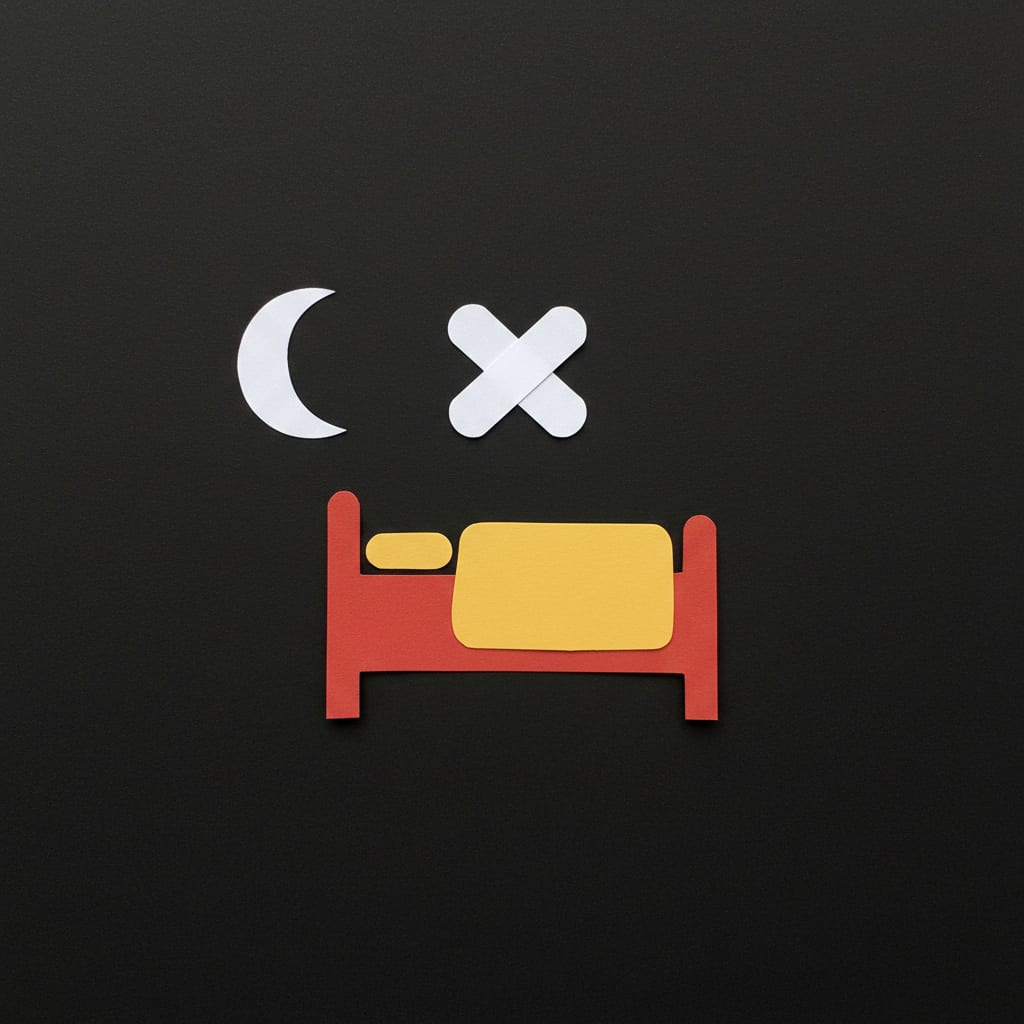
When a toddler asks for a Band-Aid on an invisible boo-boo at bedtime, they are almost never asking for first aid. They are asking for one more minute of you, and a bandage is the most official-looking way to get it. So treat it as care, not as a stall to fight: build one “boo-boo check” into the routine before lights-out, allow one bandage a night, say the same short words every time, and then end bedtime the way you always do. After lights-out, the answer is a kiss on the spot and your closing line, not a trip to the first-aid box.
The 10 tips below go in order: how to set the ritual up, what to say in the moment, and how to stop it stretching bedtime by half an hour. If your child has a real cut or stitches, that’s a different night. My stitches at bedtime guide covers it.
Why the pretend boo-boo shows up at lights-out
Two things are going on, and neither is naughtiness.
First, a bandage means “someone is looking after me.” A toddler has seen plenty of real bumps fixed with a cuddle and a Band-Aid, so the bandage has become the symbol of care. At bedtime, when you are about to leave the room, that’s exactly what they want.
Second, being tired makes small things feel bigger. Sarah Wallwork, a pain researcher at the University of South Australia, wrote in The Conversation that how we feel inside can change how much pain we feel, and that “if children are hungry or tired, the pain might seem worse.” A scratch from this afternoon really can feel worse at 7:45 p.m.
So the pretend boo-boo is part comfort-seeking and part tired body. It’s also, sometimes, a very good stall. You don’t need to work out which. The same plan handles all three.
Set up the boo-boo ritual (tips 1–4)
-
Put a “boo-boo check” into the routine, before books. One step, same place every night: after pajamas, your toddler shows you anything that hurts, you look, and you deal with it. Doing it before books, not after, means the request already has a home. When it comes up again at the door, you can say “We did boo-boo check.”
-
One bandage a night, chosen by them. Keep a small box of kids’ bandages in the bedroom drawer, like these Band-Aid Brand kids’ bandages, and let them pick the one. One a night is generous enough to feel like a yes and small enough not to turn into a pile of stickers on both arms. The picking is part of the point: toddlers like a bit of control, and choosing the design gives them some.
-
Let them do the job. Wallwork’s fifth tip is to involve children in looking after their own small hurts, “in an age-appropriate way”: getting the band-aid, a wet cloth, rubbing the area. At two or three, that means they peel the backing and press it on while you hold the arm still. A child who did the fixing is less likely to need you to fix it again ten minutes later.
-
Have a no-bandage option too. Some nights the box is empty, or there are already three on one knee. Offer something that does the same job: a kiss on the spot, a gentle rub, or a cool damp washcloth for a minute. Name it as real care, not as second best: “This one needs a kiss and a rub.”
What to say in the moment (tips 5–7)
-
Look first, briefly, every time. Get down to their level and look at the spot. That matters for two reasons. It tells your child you take them seriously, which is what they are asking for. And it means you will notice the night it isn’t pretend. The Conversation piece puts the balance well: make sure children feel safe and heard, “but don’t make a big fuss of it.”
-
Use the same three sentences. For example: “I see it. Let’s take care of it. Your body is good at healing.” Wallwork suggests reassuring children that their body will heal and the pain will pass, and talking as if they are the healers rather than the ones “getting fixed.” Same words every night become part of the routine, which is calming in itself.
-
Keep your face calm. If you look worried, a toddler learns that a boo-boo is a big deal. A quick look, a matter-of-fact “Okay, let’s fix it,” and moving on teaches the opposite. Save the concerned face for things that need it.
Stop it stretching bedtime (tips 8–10)
-
After lights-out, the answer is a kiss, not the box. If they call out “my boo-boo hurts” after the light is off, go in once, kiss the spot, say your closing line and leave. No second bandage, no lights on. This is the same rule as every other after-lights-out request in my bedtime stalling tips: the routine already covered it, so the answer is short and boring.
-
Watch for the pattern, not the single night. If boo-boos appear only at bedtime, and only after you say goodnight, it’s mostly about the goodbye. Put more warmth earlier: a longer cuddle in the chair, a proper last hug, a few minutes of talk about the day. Betteroo’s guide to the million requests at lights-out also asks whether bedtime is too early or the nap too late. A child who isn’t sleepy has more time to invent injuries.
-
Move the bandage play to the daytime. Toddlers who love bandages often love playing doctor. Give them a daytime outlet: bandage a teddy, take a doll’s temperature, run a pretend clinic on the couch. For a three-year-old, a set like the Melissa & Doug Get Well Doctor Kit (labelled for ages 3 and up) gives the game somewhere to live. If the need to care for and be cared for gets played out at 10 a.m., there’s often less of it at 7:45 p.m.
 Bedtime takes forever?
Endless requests often mean a toddler who isn't sleepy yet. Betteroo builds a nap and bedtime plan for your child's age so lights-out lands at the right time.
Take the 2-minute sleep quiz →
When the boo-boo might be real
Most invisible boo-boos are exactly that. But look every time, because toddlers can’t always explain pain well. Check properly, and call your pediatrician, if:
- the same spot keeps coming up night after night, or during the day too
- you can see swelling, redness, warmth or a bruise you can’t explain
- your child limps, won’t use an arm or leg, or holds one part of the body
- the complaint comes with a fever or your child seems unwell
If a real cut needs more than a bandage, or your child has stitches, the stitches post has the first-nights plan. And if bedtime itself has grown long and loose, tightening it with my bedtime routine checklist gives the boo-boo check a fixed place to sit.
FAQ: Band-Aids and pretend boo-boos at bedtime
Why does my toddler want a Band-Aid when nothing is wrong?
A bandage is a symbol of being looked after. Toddlers have seen real bumps fixed with a cuddle and a Band-Aid, so asking for one is asking for care. At bedtime, just before you leave the room, they want that most.
Should I give a Band-Aid for a pretend injury?
One a night, during a set boo-boo check, is fine. It costs very little and it meets the real need. The problem is only when bandages become the way to restart bedtime, which is why the limit and the after-lights-out rule matter.
Is it okay to just say no?
You can, but a flat no to “I’m hurt” tends to make a toddler push harder. A quick look and a kiss on the spot is a kinder way to say no to the bandage while still saying yes to the care.
Does this phase pass?
Usually, yes. As bedtime feels more predictable and your toddler gets plenty of warmth before the goodbye, the nightly injuries tend to fade. The daytime doctor game often hangs around longer, and that’s a good thing.