Toddler Scared of the Bathroom at Night? 10 Fixes
A toddler who uses the bathroom happily all day and won’t go near it after dark is usually reacting to three separate things: the room looks and sounds different at night, the route to it is dark, and they’re being asked to do the trip alone. Fix them in that order: light the bathroom and leave it lit, silence whatever roars when the switch goes on, light every step of the hallway, then hand the trip back in stages. Below are ten fixes in the order I run them, tested on my own two.
Which of the three you’re actually dealing with
Three checks tell you which, and they take one evening.
Walk them in with the light on and stay. Relaxed once you’re both standing in there? The room isn’t it.
Walk them to the bathroom door and stop. If they’ll step in while you stand in the hallway where they can see you, the fear is being on their own.
Watch where they freeze. A kid who won’t leave their own bedroom doorway is telling you the hallway is the scary part, and rearranging the bathroom won’t touch it.
Rule one thing out early: if daytime accidents or hiding to poop started in the same fortnight, this may be a broader wobble rather than a room-specific fear, and Betteroo’s guide to accidents that come back after training covers the usual triggers. If it’s the toilet itself they fear rather than the room at night, the daytime version is a different set of fixes.
Start with the room (tips 1–4)
-
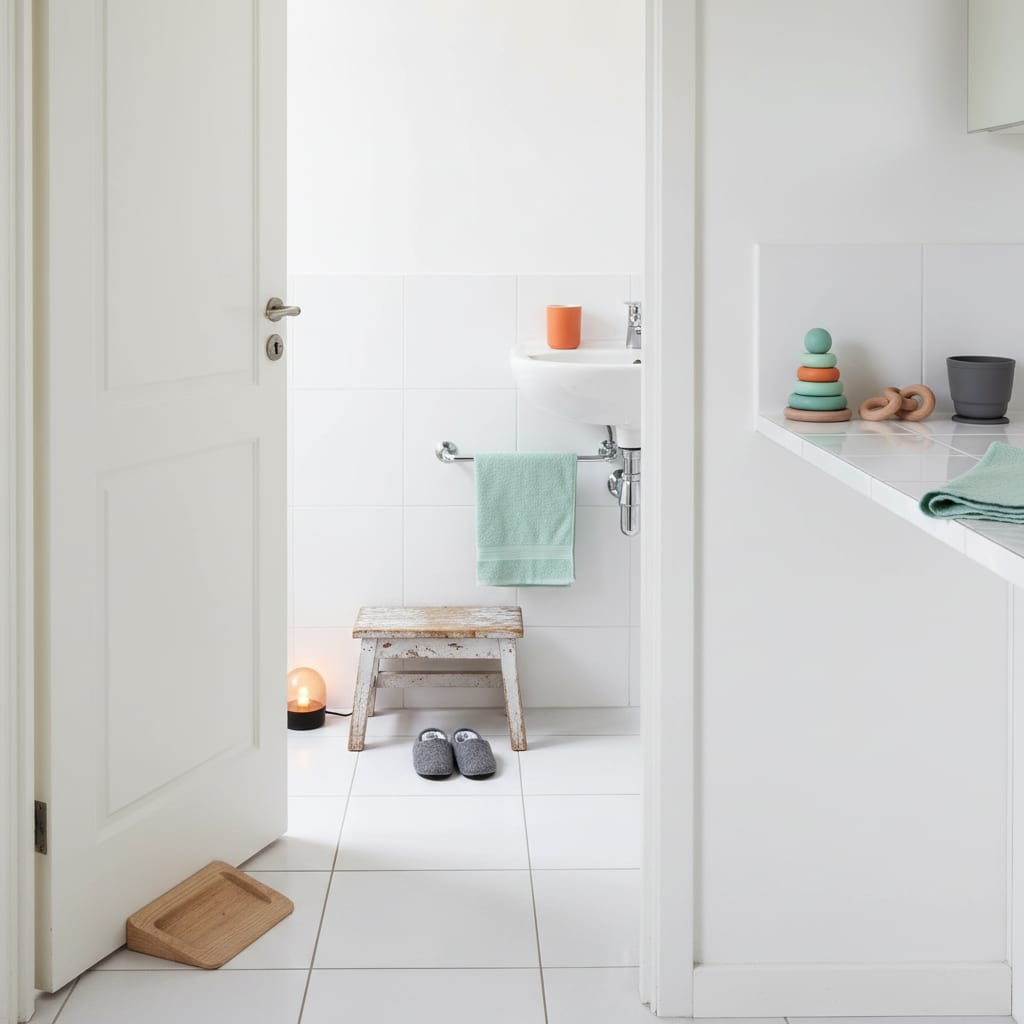
Leave a light on in there all night, and make it the same light every night. Not the overhead — a low plug-in light in the socket nearest the door, on from bath time to breakfast. The thing you’re fixing is that the room they know perfectly well is a black rectangle at 2am. Anything dimmable does it; we used a GE Ultrabrite dimmable plug-in with a dusk-to-dawn sensor, so there’s nothing for the last person to bed to switch off.
-
Check whether your extractor fan is wired to the light switch. Almost nobody checks this one. In a lot of houses the fan and the ceiling light are on the same switch, so the act of making the room safe also fills a small tiled box with a roar — and tile has nothing soft in it, so every noise is louder and sharper than it is elsewhere in the house. If yours are ganged together, stop using that switch at night: the plug-in does the lighting and the fan stays off until morning.
-
Decide what the tub looks like and never change it. Shower curtain fully open or fully closed, same every night. A half-drawn curtain makes a person-shaped bulge; a glass door ajar makes a dark gap. Pick one and set it before bed like you’d set out shoes. If the bath toys are what they stare at, move them to a basket — a heap of shapes in a dim corner is raw material for a two-year-old.
-
Don’t flush at night. Flush in the morning. For a frightened kid the flush isn’t one noise — it’s a rush, then a tank hissing and refilling long afterwards, and that second part is what follows them back down the hallway. Pee can sit in the bowl until morning.
The hallway is half the problem (tips 5–7)
-
Light the whole route with no dark stretch in the middle. Bedroom, hallway, bathroom — a chain, with the dimmest thing you own at each link. One unlit gap cancels the other two: the trip is only as easy as its worst step. Kneel at their height before deciding it’s fine. From three feet up, a hallway that reads as gently lit to you is mostly shadow.
-
Wedge both doors so they stay where you left them. A bathroom door swinging shut behind a two-year-old in a hard-walled room is a genuinely alarming event, and heavy doors and draughty hallways do it on their own. Wedge the bathroom door at the width they asked for, wedge their bedroom door the same way, and check both at your own bedtime. A door still exactly where it was at 8pm reassures more than anything you can say.
-
Shorten the trip instead of winning the argument. For a few weeks, move the destination: a potty in the corner of their bedroom turns a forty-foot journey past a staircase into four steps. It’s a detour, not a failure, and it buys sleep while the other fixes take hold. My night potty wake-up fixes cover setting that up so the trip takes ninety seconds.
Handing the trip back (tips 8–10)
-
Escort them, but be extremely dull. Go along, say almost nothing, don’t discuss what they’re scared of, don’t run a praise ceremony. Warmth without content. A trip that comes with a chat and a cuddle is worth requesting again tomorrow.
-
Fade in four stages, about a week each. In the room with them, then the doorway, then halfway down the hall answering when they call, then in your own bed answering when they call. Move on only after a solid few nights, and don’t skip a stage because one night went brilliantly. Going back up a stage after a bad week is fine.
-
Do the bathroom in daylight, when nobody is tired. Play in there in the early evening with just the plug-in on. Let them press the flush and run the fan while it’s still funny. Hide-and-seek down the hallway at dusk. Ten minutes a few times a week, nothing at stake, is where tolerance gets built — the same principle as the dark work in daylight for a kid frightened of their own room.
One honest check before you rebuild the house: if the requests are cheerful, endlessly varied and only happen between the last story and lights out, you may have bedtime stalling rather than fear. Real fear is repetitive and boring — same words, same rigid body, every night.
When it’s worth a call to your pediatrician
Fear that produces holding is the one to watch. Get it looked at if they’re holding urine or stool through the day too, if poops have turned hard or painful, if there’s blood, if peeing seems to hurt, or if the fear is spreading into rooms with no bathroom in them. Withholding stool snowballs — the longer it goes on the more it hurts, and the more it hurts the more they hold.

FAQ: the toddler who won’t go to the bathroom at night
Why is my toddler suddenly scared of the bathroom at night?
Usually nothing happened. Between two and three, kids become able to picture things that aren’t there, and a small tiled room is the perfect canvas: it echoes, it’s cold, it holds a big dark tub, and it’s the one room they’re expected to use alone in the dark. Sometimes there is a trigger — an automatic flush in a public toilet, a fan that came on by itself, a door that shut behind them.
Should I leave the bathroom light on all night?
Yes, for the duration of a fear phase — a low light, not the overhead. The overhead in a white bathroom at 2am is bright enough to tell their body the night is over, which trades a fear problem for an early-rising one.
My toddler will go if I stand in the hallway. What does that mean?
That the room isn’t the problem — being alone is. That’s a separation thing, and it responds to a predictable check-back rhythm rather than more light. Betteroo’s rundown of what clinginess looks like at this age is a useful check if it’s showing up at drop-off too.
Is it okay to put a potty in their bedroom instead?
Completely. It’s a temporary detour that keeps a newly trained kid dry while you work on the fear itself, and moving it back in stages — bedroom, landing, bathroom — is easier than winning the argument at 2am.
My toddler is holding their pee all night rather than going. Is that a problem?
Most toddlers manage overnight without a trip, so a dry night on its own isn’t alarming. What matters is whether the holding spills into the day, and whether poop is being held too — that’s the one that turns into constipation and pain, and worth raising with your pediatrician.