18 No-Mess Toddler Activities for Carpet Renters
No-mess toddler activities are the ones you can start on beige carpet, in a rental, at 4pm, without laying down a sheet first. The trick is choosing materials that are dry, big, and don’t stain: fabric, tape, cardboard, water on a surface that dries clear, and anything with a lid. Below are eighteen activities that meet that bar, sorted by roughly how long each one holds — from the two-minute rescues to the twenty-minute setups. Every one uses things you almost certainly already own, and none of them require a single photo-ready craft supply.
Quick rescues (2–5 minutes each)
-
Sock basketball. Roll every sock in the laundry basket into a ball, put the basket at the far end of the hallway, and throw. Rolled socks bounce off nothing and hurt nobody.
-
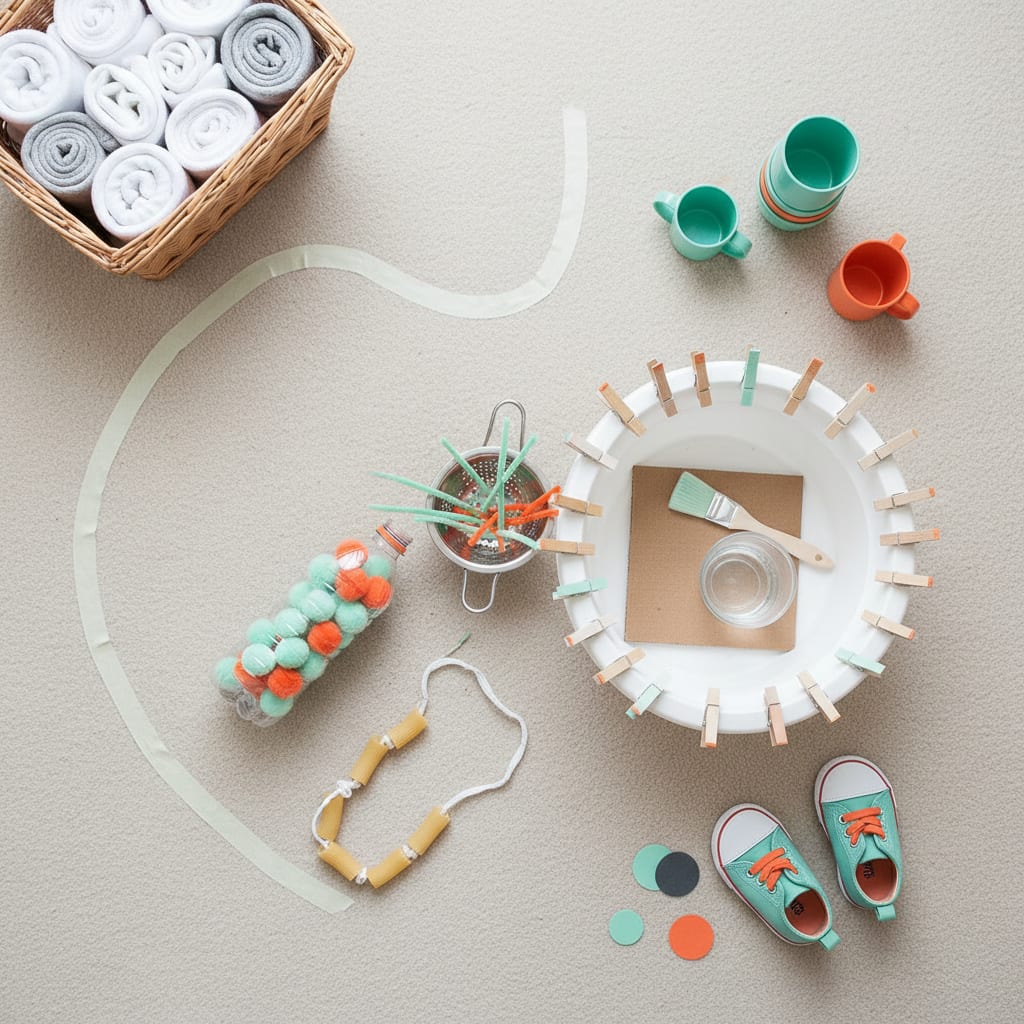
The tape road. Painter’s tape on the floor in a long winding line. Walk it, drive cars on it, jump over it. Peels up clean, which is the whole point in a rental.
-
Pom-poms into a bottle. An empty water bottle and a handful of pom-poms. Getting them in is a genuine fine-motor challenge for a one-year-old, and the spill is weightless.
-
Fridge magnet sorting. All the magnets to the bottom of the fridge door, then sort by color into two piles. Zero setup, zero cleanup, and it happens where you’re already cooking.
-
Flashlight hunt. Dim the room, hand over a flashlight, name things to find. Best five minutes in the entire winter repertoire and involves no materials at all.
-
Cushion mountain. Sofa cushions on the floor in a stack. Climb, jump, rebuild. Restack it once at the end and the room is exactly as it was.
Sit-down activities (10 minutes each)
-
Reusable sticker scenes. Cling stickers move around a background over and over without leaving glue behind. A reusable sticker pad is the one I keep in the kitchen drawer, because the stickers peel off a table, a window and a car seat with no residue.
-
Water painting on cardboard. A paintbrush, a small cup of plain water, a flattened box. The color darkens where they paint and dries back in a few minutes, so the same board lasts a week.
-
Water Wow style pads. Same principle, portable: a Water Wow pad reloads with tap water and reveals color as it’s brushed, then blanks again as it dries. It’s the single most reliable mess-free item I own.
-
Contact-paper wall collage. A sheet of contact paper taped sticky-side-out at toddler height, plus a bowl of pom-poms, ribbon scraps and cotton balls. Everything sticks to the sheet instead of the floor, and the whole thing comes down in one piece.
-
Clothespin drop. Spring clothespins clipped around the rim of a coffee can or a plastic tub, then pushed off one at a time. Frustrating in exactly the right way for a two-year-old.
-
Threading pasta on a shoelace. Dry rigatoni and a shoelace with a taped end. Big pasta, big holes, no cutting, and it all sweeps up dry.
Longer builds (15–20 minutes each)
-
The cardboard box everything. A box becomes a car, a cave, a post box with a slot cut in it, a stepping stone. It’s the highest-value object in any house with a toddler and it goes in the recycling when it’s done.
-
Tunnel course. Chairs in a row with a blanket over them, a laundry basket at one end, a cushion to climb at the other. Build it together — building it is half the activity.
-
Frozen small-world tray. Toy animals in a shallow tub of dry beans or rice with a lid, kept in the closet and brought out only occasionally. If you want the messier version done properly, my sensory bin ideas cover taste-safe fillers and containment.
-
Posting station. Cut a slot in an ice-cream tub lid; post milk-bottle lids, coasters, playing cards. Toddlers will do this for a startling length of time and nothing ends up outside the tub.
-
The dishwasher-safe kitchen game. Plastic containers and their lids, dumped on the floor, matched back together. Big, dry, and it puts your Tupperware drawer back in order afterward.
-
Blanket forts with a job. Build a fort, then give it a purpose: read three books in it, eat the afternoon snack in it, take the flashlight in. A fort without a job lasts four minutes; a fort with a job lasts twenty.
How to make any of these last longer
Two rules do most of the work. Set it up out of sight and reveal it finished — a toddler who watches you assemble something has already spent their curiosity on the assembly. And put it away while they still like it, not when they’re bored of it. An activity that disappears at the peak comes back next week at full strength; one that’s played to death is done forever.
The second half of no-mess is where you do it. A hard floor, a corner of the kitchen, or a tray with a lip contains almost anything. For the days when nothing works and it’s still raining, my rainy day activities list is the zero-prep backup, and the 30 ideas for two-year-olds hub covers what to reach for by age.
FAQ: no-mess toddler activities
What counts as a no-mess activity for a toddler?
Anything that leaves nothing to scrub: dry materials, big pieces, water that dries clear, and adhesives that peel. If cleanup takes longer than the activity did, it isn’t a no-mess activity no matter what the internet calls it.
How do I entertain a toddler in a small apartment?
Go vertical and go physical. Contact paper on a wall, tape lines down a hallway, cushion climbing, posting games at a low table. Small spaces are fine for toddlers — what they can’t tolerate is a whole day without anything to climb on.
What no-mess activities work for a one-year-old?
The posting and dropping games: pom-poms into a bottle, lids into a slot, containers and lids, socks into a basket. Anything with pieces small enough to swallow needs supervision and a size check first — at this age the mouth is still part of how they investigate.
How long should a toddler activity last?
Five to fifteen minutes is normal for ages one to three, and that’s not a failure of the activity. Plan the afternoon as four short things rather than one long thing, and rotate rather than repeat.
How do I keep activities from getting boring?
Rotate them out of sight. Keep two-thirds of what you own in a closet and swap a few items each week. An activity that has been sitting in the toy bin for a month reads as furniture; the same one reappearing after three weeks reads as new.