15 Toddler Sensory Bin Ideas From the Pantry
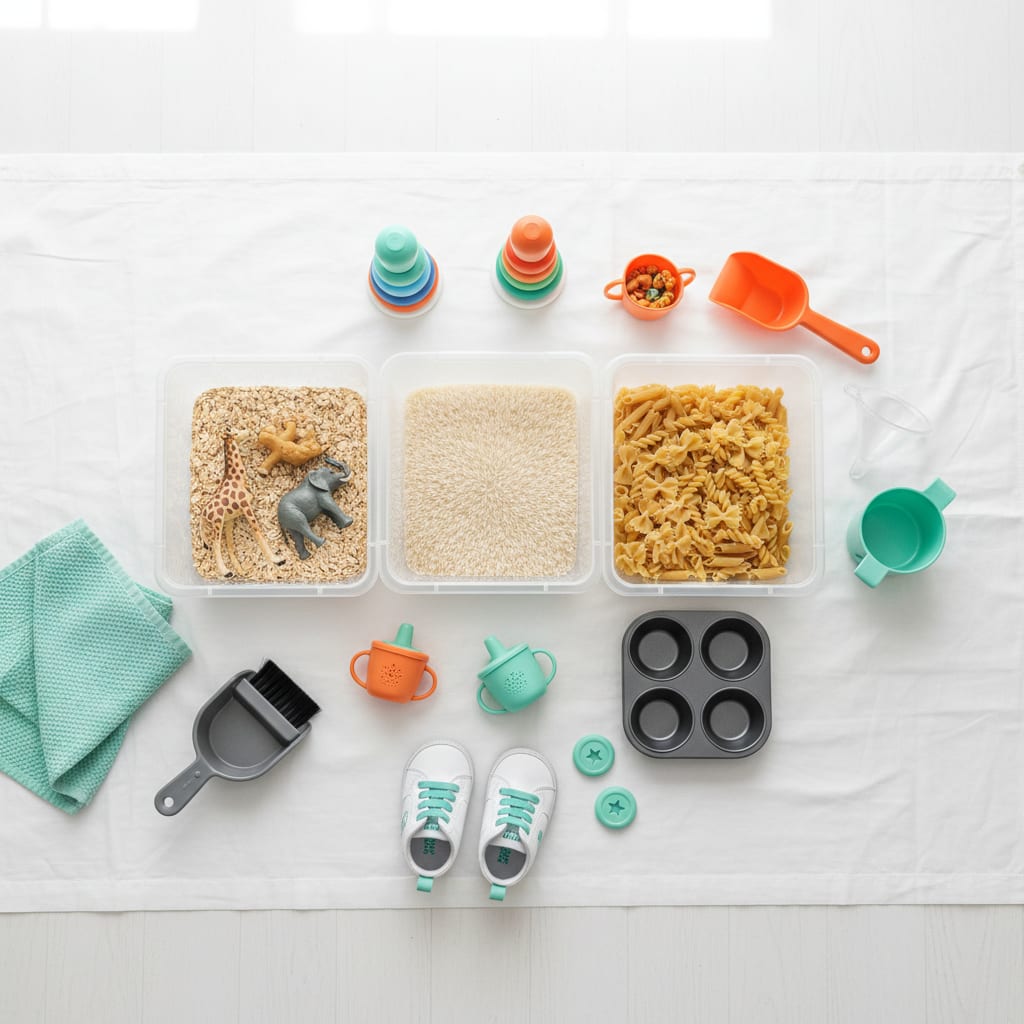
A toddler sensory bin is a shallow tub of something pourable plus two or three tools, and the good news is you already own everything for at least five of them. The only real decision is the filler: at one and two, kids still mouth things, so the pantry — oats, rice, pasta, cereal, water — beats craft-store beads and water beads every time, because the worst-case outcome is a mouthful of dry oats rather than an emergency. Below are 15 bins built from things in your kitchen right now, each with the tools that make it last and an honest note on the mess.
Safety first, and it’s not optional: stay in the room, sit down with them for the first few minutes of any new filler, and skip small hard fillers entirely for a determined mouther. Never leave a toddler alone with water, even an inch of it. Dried beans, corn kernels and popcorn are choking-and-inhalation risks for the under-threes — they’re on the “wait” list below, not the good list.
Taste-safe bins for the under-twos (and any dedicated mouther)
- Oat bin. Old-fashioned rolled oats, a scoop and two cups. The gold standard: soft, cheap, sweeps up, and completely fine if a handful goes in the mouth. This is the bin I’d start any one-year-old on.
- Cornmeal or polenta “sand.” Finer than oats, holds a shape when packed, and makes a satisfying pouring sound. Slightly dustier — put a sheet underneath.
- Baby cereal snow. A box of flake baby cereal in a tub with small animals to bury. Tastes fine, costs almost nothing, and washes off skin instantly.
- Whipped-cream cloud tray. A can of whipped cream on a rimmed baking tray with two spoons. Entirely edible, twenty gloriously sticky minutes, ends in a bath.
- Water bin with a job. An inch of warm water, a squirt of dish soap, plastic dishes to wash. Towel underneath, and you never step away — an inch of water is still a drowning hazard for this age.
- Ice rescue. Small plastic animals frozen into a tub overnight, freed with warm water and spoons. Freeze one the night before every rainy forecast.
- Cooked spaghetti. Cooked, cooled, drained, a splash of oil so it doesn’t clump. The texture is the whole activity, and it’s totally safe to taste.
Bins for two-and-a-half and up (past the mouthing stage)
- Dry rice with a funnel station. Rice, a funnel, a jug and a couple of cups. The most reloadable bin there is — decant it back into a jar afterwards and it lasts all year.
- Dry pasta by shape. Penne, shells and macaroni in one bin, with a muffin tin for sorting. The sorting job outlives the pouring by about ten minutes.
- Cereal-loop threading tub. O-shaped cereal in a bin with pipe cleaners for threading. Fine-motor work disguised as snack time.
- Coffee-bean digging bin. Whole beans in a bin with a small trowel and toy trucks. The smell is a genuine part of the appeal, and it’s the tidiest of the dry fillers because the beans are big.
- Shredded-paper “grass.” Junk mail through a shredder, plus buried treasure. Free, and the only bin whose mess is technically already trash.
- Flour-and-oil moon sand. Eight parts flour to one part vegetable oil, mixed in the bin itself. Holds shapes for scooping and molding. Messy but flour sweeps.
- Soap-foam bin. A squirt of dish soap plus a little water whisked into stiff foam with a hand mixer. Enormous volume from almost nothing; add cups and a spoon.
- Kinetic sand on a rimmed tray. Kinetic Sand is labeled for ages three and up, so it belongs to the older end — but with a rim around it, it’s the least escapable sensory material I’ve used indoors.
On the wait list: water beads, dried beans, corn kernels, small pom-poms and pebbles. All popular online, all genuinely risky before three — water beads swell after swallowing, and beans and kernels are exactly the size and shape that cause problems. Nothing on that list is worth the twenty minutes.
The setup rules that make a bin last
Contain it before you fill it. An old shower curtain, a flat bedsheet or a splat mat under the bin turns cleanup from a vacuum job into a lift-and-pour. A bin inside an empty kiddie pool is the professional-grade version.
Two or three tools, not ten. A scoop, a funnel and one container. Loading a bin with every kitchen implement you own shortens play rather than extending it — the choosing eats the time. A dedicated set of chunky scoops and tweezers sized for small hands is the one non-pantry purchase that genuinely earned its place here.
Set it up before they’re in the room. A bin discovered fully laid out gets a much longer run than one assembled while a toddler hangs off your arm — the same rule that governs everything in my activities for 2 year olds list.
Give them the broom afterwards. A dustpan and a small brush turns the cleanup into round two. Toddlers genuinely like sweeping; it’s the only chore with a 100% participation rate at this age.
Store the filler, not the bin. Dry fillers go back into a labeled jar and get reused for months. That’s what makes rice or pasta a two-dollar activity instead of a two-dollar-per-session activity.
Time them right, too. Sensory bins are strongest in the ugly stretch before dinner, when everyone’s fraying and nobody wants to start something that needs you — pair one with a snack from my two-minute snack list and you’ve covered the worst hour of the day. If the fraying starts earlier every week, though, that’s usually a nap-timing problem rather than an activity problem — Betteroo’s toddler sleep plan re-times the day from this morning’s actual wake-up, and fixes more afternoons than any bin will. On a wet housebound afternoon they slot into the middle of the sequence in my rainy day activities, and for an older sibling doing the same hour alone, the solo versions are in my quiet time activities.
FAQ: toddler sensory bins
What is the best filler for a toddler sensory bin?
Rolled oats for anyone still mouthing things — soft, cheap, sweeps up and harmless if tasted. Dry rice and dry pasta are better after two and a half because they pour beautifully and store for months. Water is the most reliable filler of all, with an adult sitting right there.
At what age can a toddler use a sensory bin?
Around 12 months, with an adult sitting beside them and a taste-safe filler only. Between one and two the rule is simple: assume everything goes in the mouth, and choose the filler accordingly. Small hard fillers wait until mouthing genuinely stops, usually somewhere past two and a half.
Are water beads safe for toddlers?
No — not for this age group. They swell after being swallowed and are a well-documented hazard for young children. Every appealing thing about them can be got from ice cubes, cooked pasta or soap foam instead, with none of the risk.
How do I stop a sensory bin making a huge mess?
Put the bin inside something bigger — a shower curtain, a splat mat or an empty kiddie pool — use a bin with high sides, limit the tools to three, and hand over a dustpan and brush at the end. Trays with a rim are the single best container for the messiest fillers.
How long does a toddler play with a sensory bin?
Realistically 10 to 25 minutes, and longer if you add a job to it — burying and finding, sorting by shape, filling a jar to a line. Open-ended pouring alone tends to run out sooner than a bin with a small task in it.