Quiet Time Activities for 3 Year Olds: 20 Nap-Drop Savers
Quiet time is what replaces the nap when a three-year-old stops sleeping but still needs a break in the middle of the day — and so do you. The activities that work for it share one trait: they run without an adult. No instructions, no turn-taking, no “come and look at this.” Below are 20 setups that hold a three-year-old solo in one room for somewhere between fifteen and forty minutes, plus the rules that make quiet time an actual routine instead of a daily negotiation. Everything here has been run in my house during the messy in-between months when the nap was gone but the afternoon still needed a wall in it.
Ground rules first, because the activities only work inside them: same room, same time each day, door open, and a timer they can see so the end of quiet time is a fact rather than your opinion.
The setups that hold longest (do these first)
- A rotating quiet-time box. One lidded bin that only comes out at quiet time and gets swapped every couple of weeks. Novelty is the entire mechanism — the same six toys are thrilling again after a fortnight in the closet.
- Sticker books, the reusable kind. Reusable sticker pads peel and re-stick, which means one pad survives dozens of quiet times instead of being used up in one.
- Magnet tiles on a baking tray. A set of Magna-Tiles works; the tray gives it a boundary, which oddly makes the play last longer. Vertical works too — stick the tray on the fridge for a standing version.
- A “library” of ten books in a basket. Not the shelf, a basket. Ten spines facing up beats forty spines facing sideways for a kid choosing alone.
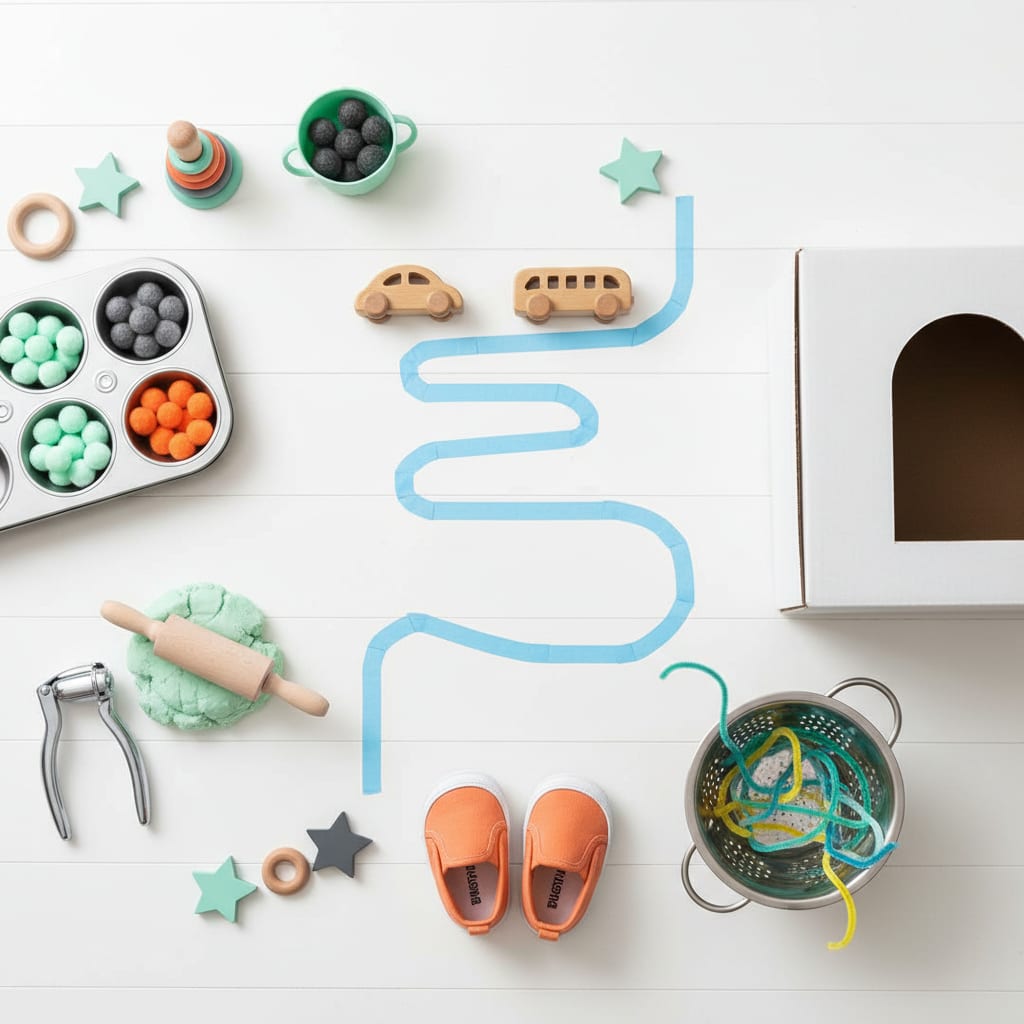
- Play dough with real kitchen tools. A garlic press, a pizza cutter and a rolling pin. Play-Doh’s ten-pack is the cheapest way to keep colors going without a weekly restock.
- Water painting on the window or door. A cup with an inch of water and a chunky brush. Paints, dries, repeats, cleans up on its own.
- A sorting job with real stakes. A bag of mixed buttons or bottle caps and an ice-cube tray. Sorting by color is the assignment; nobody checks the work.
- Lacing beads or pasta on a shoelace. Fine-motor, silent, and the threading loop is genuinely absorbing at three.
Pretend-play setups (one prompt, then leave)
- The vet clinic. Stuffed animals, a roll of bandage-style masking tape, a bowl of “medicine” water. Set the scene once, say nothing else.
- Doll or bear bedtime. Every animal has to be tucked in properly, which involves finding blankets. A three-year-old will run this for twenty minutes unprompted.
- Small-world tray. A shallow tray, some dried beans or rice, three dinosaurs and two toy cars. The container is what makes it a quiet-time activity rather than a floor situation.
- Post office. Old envelopes, junk mail, stickers as stamps, a shoebox with a slot cut in the lid. Posting things remains undefeated at this age.
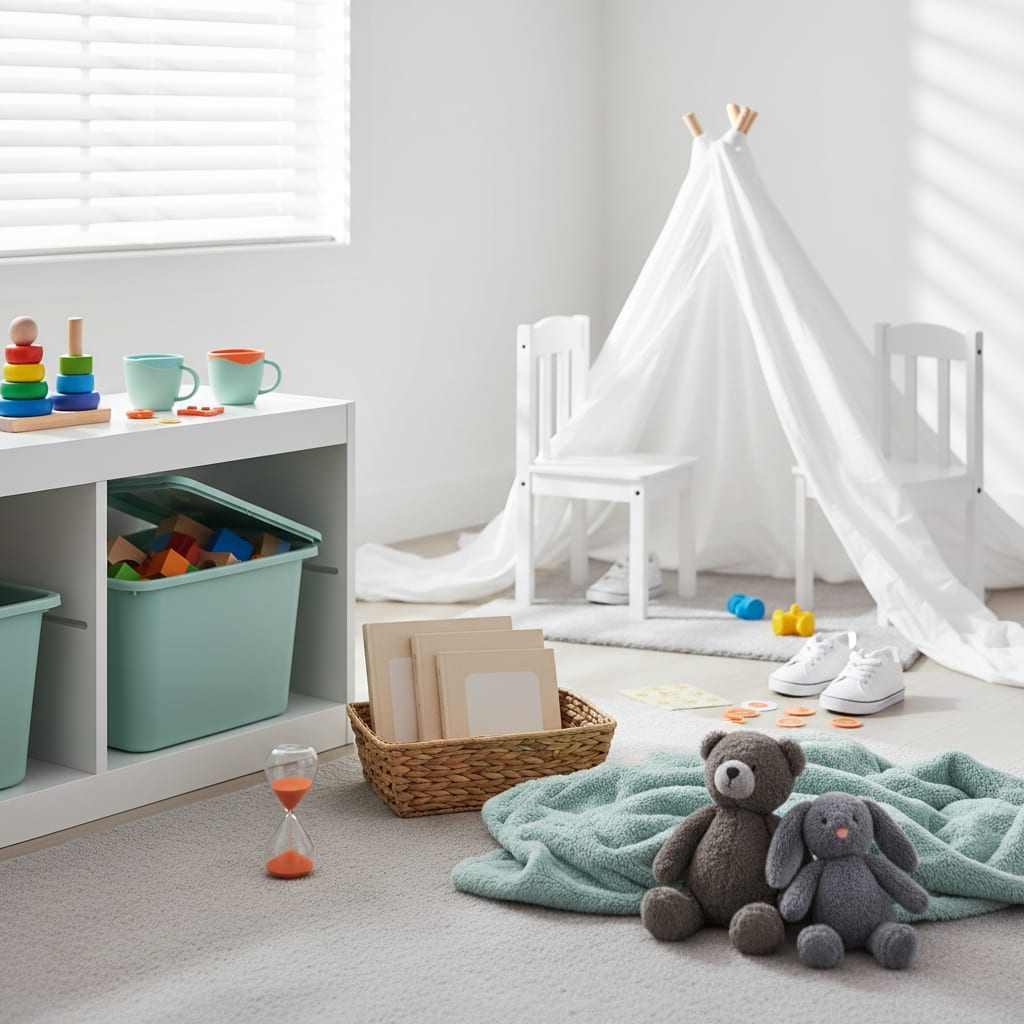
- Camping in a sheet fort. Two chairs, a sheet, a flashlight and the book basket. Kids stay inside a fort long after they’d have left a plain room.
Table and floor work (set it up before they walk in)
- Do-a-dot painting or chunky crayons on butcher paper. Tape a long sheet to the floor or table so it can’t slide, and they’ll fill it.
- Scissors practice on junk mail. Toddler safety scissors and a stack of catalogues to cut into confetti. Supervise from the doorway; three is often the age this clicks.
- Puzzles slightly below their level. A puzzle they can finish alone gets done four times; one they can’t gets abandoned in ninety seconds and ends quiet time early.
- Threading a colander. Pipe cleaners into a plastic colander’s holes. Two minutes to set up, weirdly durable interest.
- A pantry sensory tray. Dry oats or rice, scoops, funnels, a few cups. My sensory bin ideas has the taste-safe fillers and the containment tricks if it’s new to you.
- Audiobooks or a story podcast with headphones. For the last stretch, when the setups are exhausted and they’re genuinely tired. Not a screen, still a break.
- Doing nothing, on purpose. The most underrated one. A kid lying on the floor staring at the ceiling for twenty minutes is quiet time working exactly as designed — boredom is where independent play starts.
How to make quiet time actually stick
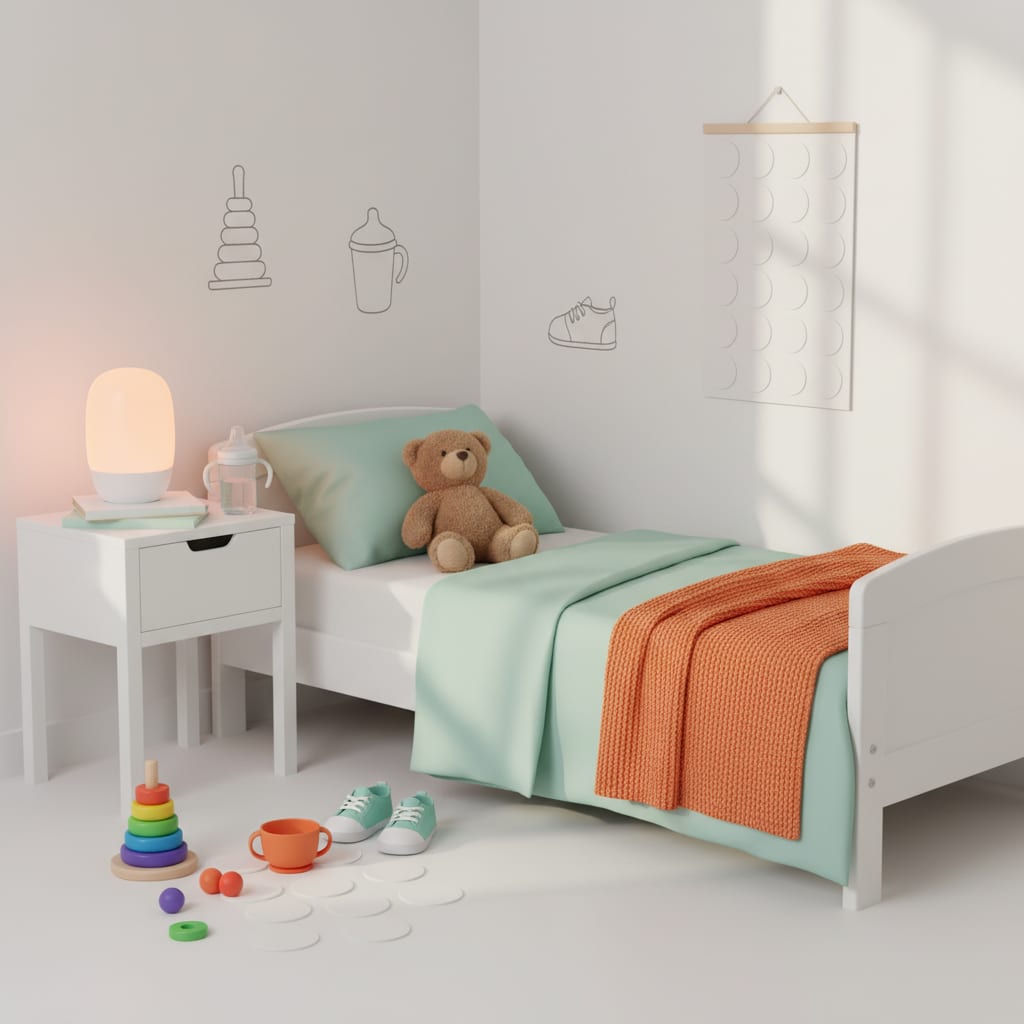
Set the container before you worry about the contents. Same time every day, ideally the old nap slot, because their body still expects a dip there. Same place, usually their bedroom, so the room does half the work. A visible timer — a sand timer or a visual countdown timer with a colored disk that shrinks — because “when the color is gone” is a rule a three-year-old can accept and “when I say” is one they’ll test daily.
Start short. Fifteen minutes that ends well beats forty-five minutes that ends in shouting, and you can add five minutes a week almost invisibly. Expect the first fortnight to be the hard part; expect them to come out repeatedly; walk them back with the same flat sentence every time, exactly as you would at bedtime — my won’t-stay-in-bed tricks are the same escalation ladder, just at 1pm.
And know where you are in the process. Most kids drop the nap somewhere between three and five, often unevenly — napping some days, not others, for months. On the no-nap days, bedtime usually needs to move earlier by 20 to 30 minutes or you get an overtired evening; if you’re still mid-wobble, my nap refusal tips cover the days when the nap is still salvageable, and the broader activities for 2 year olds list works for the younger sibling doing the same hour downstairs.
FAQ: quiet time for 3 year olds
How long should quiet time be for a 3 year old?
Start at 15 minutes and build toward 45 to 60 over several weeks. An hour is a realistic ceiling for most three-year-olds. Ending it while it’s still going well is what makes tomorrow’s session possible — pushing for one more song is how quiet time dies.
What if my 3 year old won’t stay in their room for quiet time?
Treat it like bedtime: a visible timer, a boring calm walk back, and the same short sentence every single time. Shorten the session until they can succeed at it, then extend. And check the timing — quiet time scheduled too early in the afternoon will always be a fight.
Should a 3 year old still nap?
Some do, some don’t, and most spend months doing both depending on the day. Neither is a problem. The useful move is to keep the slot regardless — nap if they sleep, quiet time if they don’t — so the rhythm of the day doesn’t collapse every time they skip.
What are good quiet time activities that don’t make a mess?
Reusable sticker pads, magnet tiles on a tray, a book basket, lacing beads, puzzles, water painting and audiobooks. Anything with a tray or a boundary contains itself. Skip glitter, paint and glue for solo sessions — save those for when you’re in the room.
Does quiet time replace the nap for a 3 year old?
Not physiologically — a rest isn’t sleep — but it does replace the function. Kids come out calmer, the late afternoon goes better, and bedtime is less brutal than on a no-break day. On the days there’s no nap at all, move bedtime earlier to cover the gap.