Restaurants With a Toddler: A Survival Order of Operations
Taking a toddler to a restaurant works when you stop treating it as a meal and start treating it as a timed operation. The sequence matters more than any single trick: go at the right point in their day, get seated somewhere with an escape route, order everything the second you sit down, feed the toddler first, and leave while it’s still going well. Below is the exact order of operations I run — fourteen steps from the moment you pick the place to the moment you’re back in the car — tested with two toddlers twenty months apart, in real restaurants, with real other diners nearby.
Before you leave the house (steps 1–4)
-
Pick the slot, not the restaurant. The window that works is roughly an hour after a nap ends and at least 45 minutes before the next meltdown cliff — for most toddlers that’s an early lunch or a 5pm dinner, not 7:30. If you only know one thing about your kid’s day, know when the nap ends: a solid nap that finishes at a predictable time is what makes the whole outing possible, and Betteroo’s 18-month nap and bedtime timings are a useful sanity check if yours drifts.
-
Call ahead with three questions. Do you have high chairs, how long is the wait, and can you seat us in a corner or a booth. Ninety seconds on the phone removes the two worst variables — standing in a lobby with a hungry toddler, and a table in the middle of a walkway.
-
Feed a small snack in the car. Counterintuitive, but a starving toddler cannot wait fifteen minutes for food, and the crash happens before the plates arrive. Half a banana or a handful of crackers on the drive buys you the ordering window. My two-minute snack ideas are the list I raid for this.
-
Pack the bag with one new thing. Not the whole toy box — three or four small items and one thing they haven’t seen this week. A Water Wow pad lives permanently in mine because it’s mess-free and reloads with plain water. If you want a repeatable version of this, build a dedicated pouch: my busy bag ideas are exactly this bag, done in advance.
The first five minutes at the table (steps 5–8)
-
Take the seat with the escape route. Toddler on the inside if you want them contained, toddler on the aisle side of you if you expect multiple exits. The adult on tantrum duty sits closest to the door. Decide this before anyone sits down, not during.
-
Clear the table zone immediately. Salt, pepper, sugar packets, cutlery, the little vase, anything glass — all of it goes to the far end within ten seconds of sitting. Everything within a toddler’s arm span is a projectile until proven otherwise.
-
Order everything at once, including the check request. Kid’s food, your food, drinks — one pass. Tell the server, plainly, “we’re on toddler time, could you bring their food as soon as it’s up, and the check whenever it’s convenient.” Servers are almost always glad to know the plan.
-
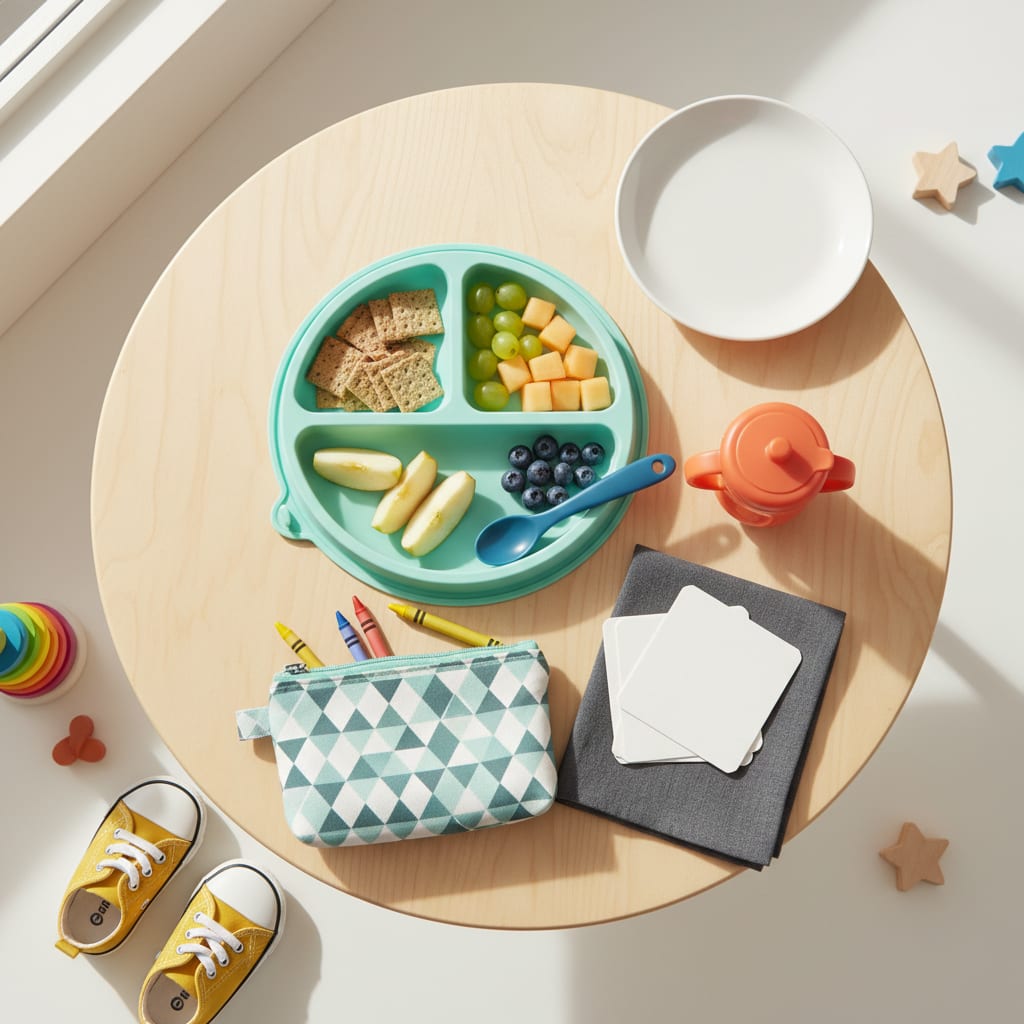
Put something on the table before the food comes. A suction plate with a few crackers on it turns the empty-table wait into a task. The ezpz Mini Mat is the one we bring because it sticks down and doesn’t get flipped, which matters more in a restaurant than at home.
The middle stretch (steps 9–12)
-
Feed the toddler first and let the timeline stay uneven. Their food arrives, they eat, they finish while you’re still waiting. That’s the design, not a failure. A toddler who eats at minute eight is a toddler who’s content at minute twenty.
-
Rotate the entertainment slowly. One item at a time, out of the bag and back in. Producing all four at once burns your entire supply in six minutes. Stickers, a small pack of crayons, the water pad, then a napkin-and-straw game — that’s four rounds out of what looks like one handful.
-
Take a lap when the wriggling starts. Don’t wait for the shriek. The moment they start standing on the seat, one adult takes them on a loop — to look at the fish tank, out to the sidewalk, past the kitchen door. Two minutes of walking resets ten minutes of sitting.
-
Have a food-throwing rule and use it once. In public the answer is the boring one: pick it up, say the short line, remove the plate if it happens again. Restaurants aren’t the place for a new discipline strategy, they’re the place for one you’ve already run at home — my food-throwing fixes are the version to practise at your own table first.
The exit (steps 13–14)
-
Leave at the first yawn, not the last chance. The single biggest mistake is staying for coffee. When the toddler is done, the outing is done — box up what’s left, pay the check you already asked for, go. Ending well is what makes anyone willing to try again next month.
-
Do the bathroom run on your terms. If you’re mid potty-training, take them before the food arrives rather than after the first “I need to go” — restaurant bathrooms are far from your table and the timing is never generous. My potty training out of the house tips cover the car kit and the scripts for this.
What actually buys you the extra twenty minutes
Three things do most of the work, and none of them are toys. Order first — the gap between sitting down and food hitting the table is where every restaurant meltdown is born. Sit somewhere with a wall on one side, because a booth gives a toddler only one direction to escape in. And tip well when it goes badly: the server who watched you crawl under the table for a fork is the one who’ll find you a corner booth next time.
Also, lower the bar. A successful restaurant trip with a toddler is 40 minutes of everyone eating, not a leisurely evening — measured against the leisurely evening, a perfectly normal outing reads as a failure.

FAQ: taking a toddler to a restaurant
What is the best time to take a toddler to a restaurant?
About an hour after the nap ends, and early — 11:30 for lunch, 5pm for dinner. You get a rested kid, a quieter dining room, faster service and an exit long before bedtime. The 7pm reservation is where good intentions go to die.
How do I keep my toddler seated at a restaurant?
Give the seat a purpose. Something on the table from the second you sit, food arriving early, entertainment rotated one item at a time, and a walking lap before the wriggling turns into standing. Expect to trade a two-minute lap for every ten minutes of sitting — that’s a good exchange rate.
Should I bring a tablet to a restaurant with a toddler?
That’s a family call, and there’s no judgment here either way. If you do, treat it as the last card in the deck rather than the first — once the screen is on, nothing else in the bag will compete with it, and you’ve spent your whole reserve at minute five.
What should I pack in a restaurant bag for a toddler?
A suction plate or placemat, one snack, wipes, a spare set of clothes for under-twos, and three or four small quiet items including one thing that’s new to them this week. Keep it in the car permanently so a spontaneous meal out doesn’t require a packing session.
Is it rude to bring a toddler to a restaurant?
No — but pick the venue honestly. Casual and loud is a fine place for a one-year-old; a quiet tasting-menu room at 8pm is not. Go where the noise floor is already high, and clean up the worst of the floor before you leave.