Activities for 1 Year Olds: 25 Ideas That Aren't Screens
The activities that hold a one-year-old are almost embarrassingly simple: put something in, take something out, bang two things together, make it fall over. At this age they’re not building anything — they’re testing what objects do, over and over, which is why a bowl of clothespins outperforms a light-up toy every time. Below are 25 ideas you can set up in about two minutes from things already in your house, sorted by what they demand of you, with an honest note on which ones bought me real time and which lasted four minutes.
Cautions throughout, and they matter more at one than at two: stay in the room, keep anything that fits through a toilet-roll tube out of reach, never leave a toddler alone with water even an inch of it, and expect everything to go in the mouth at least once.
Dump, fill and post (the highest-yield category at this age)
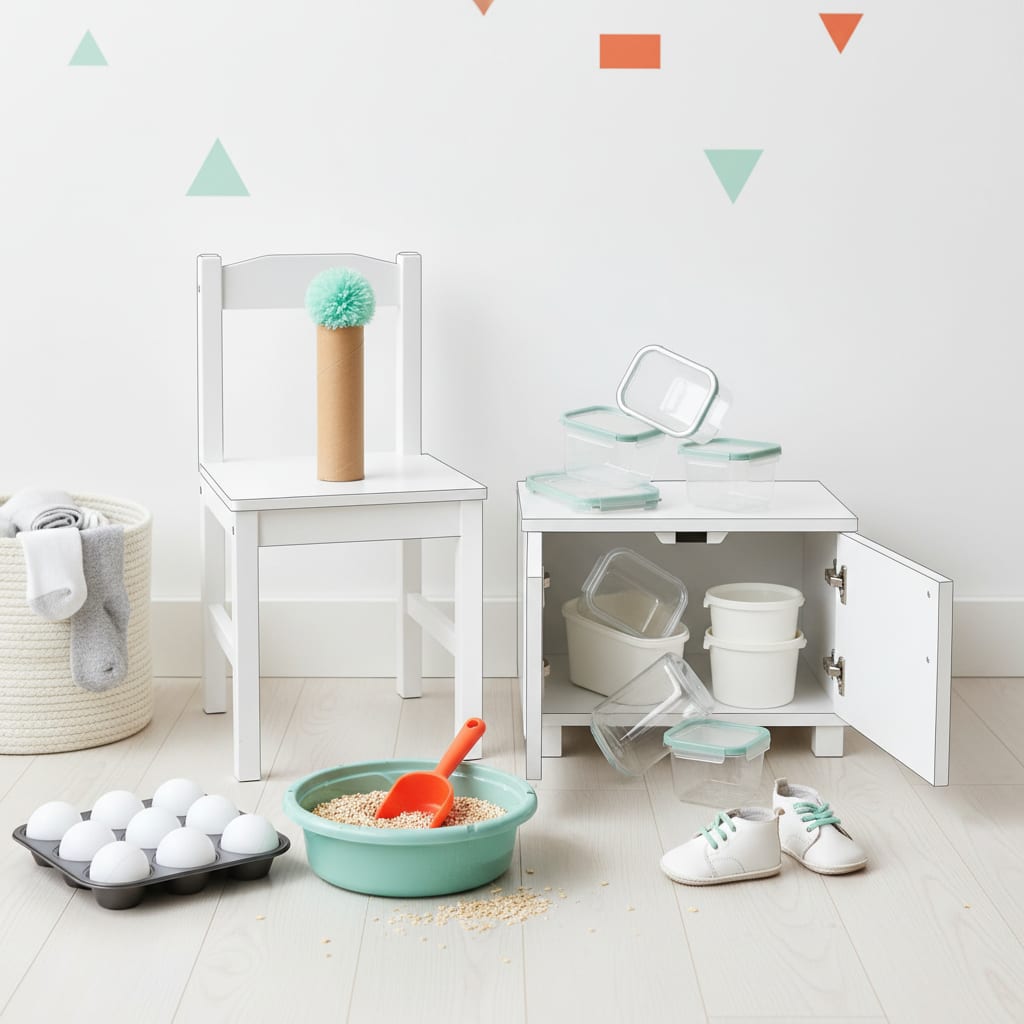
- The tupperware cupboard. One low cupboard they’re allowed to empty. Free, infinitely repeatable, and the single most-used activity in my house that year.
- Ball drop through a paper-towel tube. Tube taped to the wall or the sofa side, pom-poms or small balls in the top. Cause and effect, twenty times in a row.
- Wipe container posting. An empty wipes tub and a stack of cut-up sponge pieces or scarves. Pushing things through a resistant slot is deeply satisfying at one.
- Coin-slot shoebox. A slot cut in a shoebox lid, plus big plastic lids or jar lids to post. Nothing coin-sized — nothing that fits through a toilet-roll tube.
- Muffin tin and ping-pong balls. Twelve holes, twelve balls. They’ll fill it, tip it, and fill it again.
- Sock ball basket. Rolled socks and a laundry basket. Doubles as sorting the actual laundry, which is the only reason it’s on the list.
- Cardboard box with doors. A big box with a flap cut in the side. A one-year-old will go in and out of it for a genuinely unreasonable length of time.
Sensory play that’s safe for a mouther
- Oat bin with a scoop. Rolled oats, a cup and a spoon in a shallow tub. Taste-safe by design; more taste-safe fillers are in my sensory bin ideas.
- Ice cubes in a warm-water bowl. Two bowls, some ice, a slotted spoon. Watch the water the whole time.
- Cooked spaghetti tray. Cooked, cooled, lightly oiled. Squishy, edible, ends in a bath.
- Contact-paper wall. Sticky-side-out at their height, plus torn tissue paper and fabric scraps. The vertical surface is what makes it work for wobbly shoulders.
- Whipped-cream tray. A can of whipped cream on a rimmed tray. Entirely safe to eat, entirely chaotic, worth it.
- Frozen-berry ice tray. Berries frozen into water in an ice-cube tray, dropped into a shallow bowl. Cold, colorful, edible.
- Sponge squeezing. Two bowls, one with an inch of water, three sponges. Never step away from it.
Movement for brand-new walkers
- Cushion mountain. Sofa cushions on the floor to climb, crawl over and fall onto. Do not underestimate how long this holds.
- Push-along with a laundry basket. An empty basket to push around the room, weighted with a book if they need more resistance. Cheaper and better than most walker toys.
- Tunnel under the dining table. A sheet over the table, cushions at each end. Crawling has a long tail even after walking starts.
- Balloon batting. One balloon, floor is lava. Bin every fragment immediately if it pops — deflated balloon pieces are a serious choking hazard.
- Stair practice, supervised. Up two steps, turn around, come down backwards. It’s a skill they want badly, and practising it with you beats discovering it alone.
- Music and marching. Loud song, wooden spoons, everyone stomps. Ninety seconds of setup, ten minutes of energy burned.
Quiet-ish wins for the tail end of the day
- Board books in a basket, spines up. Ten books facing up in a basket beats forty on a shelf for a kid choosing alone.
- Chunky puzzles with knobs. One or two pieces at a time is the right difficulty at this age; a nine-piece puzzle just gets scattered. A Melissa & Doug jumbo-knob puzzle is the classic version.
- Mirror play. Sit them in front of a low mirror with a hat and a scarf. Simple, and reliably funny to them.
- Peekaboo with a tea towel. The oldest activity on the list and still one of the best — object permanence is genuinely hot news at twelve months.
- Water painting the fence or bath tiles. A cup of plain water and a fat brush. Zero cleanup, and it works indoors on tiles too.
How to get more than four minutes out of any of them
Three things do most of the work at this age. Sit down first — a one-year-old plays longer beside a seated adult than beside a hovering one, so get on the floor and let them bring you things. Rotate, don’t add: keep two-thirds of the toys in a closet and swap a bin every fortnight; the same stacking cups are brand new after two weeks away. And set it up before they’re in the room, because an activity discovered fully laid out gets a much longer run than one assembled with a small person attached to your leg.
Then adjust for the day they’re actually having. Attention at twelve to eighteen months comes in short bursts, and a kid who leaves and comes back three times has still played — that’s normal, not a failure of the activity. If everything is falling flat by 4pm, the problem is usually timing rather than ideas: this is the year most kids are dropping down to one nap, and the weeks around that switch make every afternoon shorter-fused. It’s also worth knowing roughly what’s typical around 13 months so you’re pitching activities at the skills they actually have.
When they graduate out of the dump-and-fill era, the next step up is my activities for 18 month olds, then the activities for 2 year olds, and for a wet day when nobody’s leaving the house, the sequenced version is my rainy day activities for toddlers.
FAQ: activities for 1 year olds
How do I entertain a 1 year old at home all day?
Don’t try to fill the whole day — run three or four short set-ups at the hard hours (mid-morning, before lunch, the stretch before dinner) and let the rest be pottering. Front-load the physical ideas, save the tray-based ones for late afternoon, and pair the 4pm one with a snack.
How long should a 1 year old play with one activity?
A few minutes is completely normal, and ten is a genuine win. Attention comes in bursts at this age. A toddler who wanders off and returns three times has still played for twenty minutes — leaving the setup out is often more effective than trying to hold them at it.
What toys are best for a 1 year old?
Containers, balls, blocks, board books and anything with a lid. Objects that do one simple thing beat toys that do five, because the child supplies the game. Most of the best options at twelve months are already in your kitchen cupboards.
Do 1 year olds need screens or educational apps?
No — at this age, the learning happens in the hands. Pouring, posting, climbing and knocking things over is the curriculum. That’s a practical point rather than a moral one: a bowl of clothespins genuinely holds a one-year-old longer than a video does.
What can I do with a 1 year old while I cook?
Give them a job on the floor at your feet: a low cupboard of tupperware, a muffin tin with ping-pong balls, or their own bowl and wooden spoon. Set it up before you start cooking rather than after the whining begins, and expect to reset it twice.