Toddler Falls Out of Bed? 13 Tips for Rails and Bumps

If your toddler keeps falling out of bed, make the fall shorter and softer tonight. Drop the mattress as low as it goes, or put it on the floor. Pad the landing side, and fit a rail that sits flush against the mattress with no gap. Most tumbles from a low bed end in a startled cry and a cuddle. Some don’t, so learn the head-injury signs before you need them. A toddler who passes out, has a seizure or can’t be woken needs 911. Repeated vomiting, unusual drowsiness or not acting like themselves means the emergency room. Thirteen tips below: the bed first, then the rail, then what to watch for after a bump.
The clip-on rail was one line in my crib-to-toddler-bed switch tips. This post is the follow-up for when one rail wasn’t enough.
Tonight: make the fall shorter (1–4)
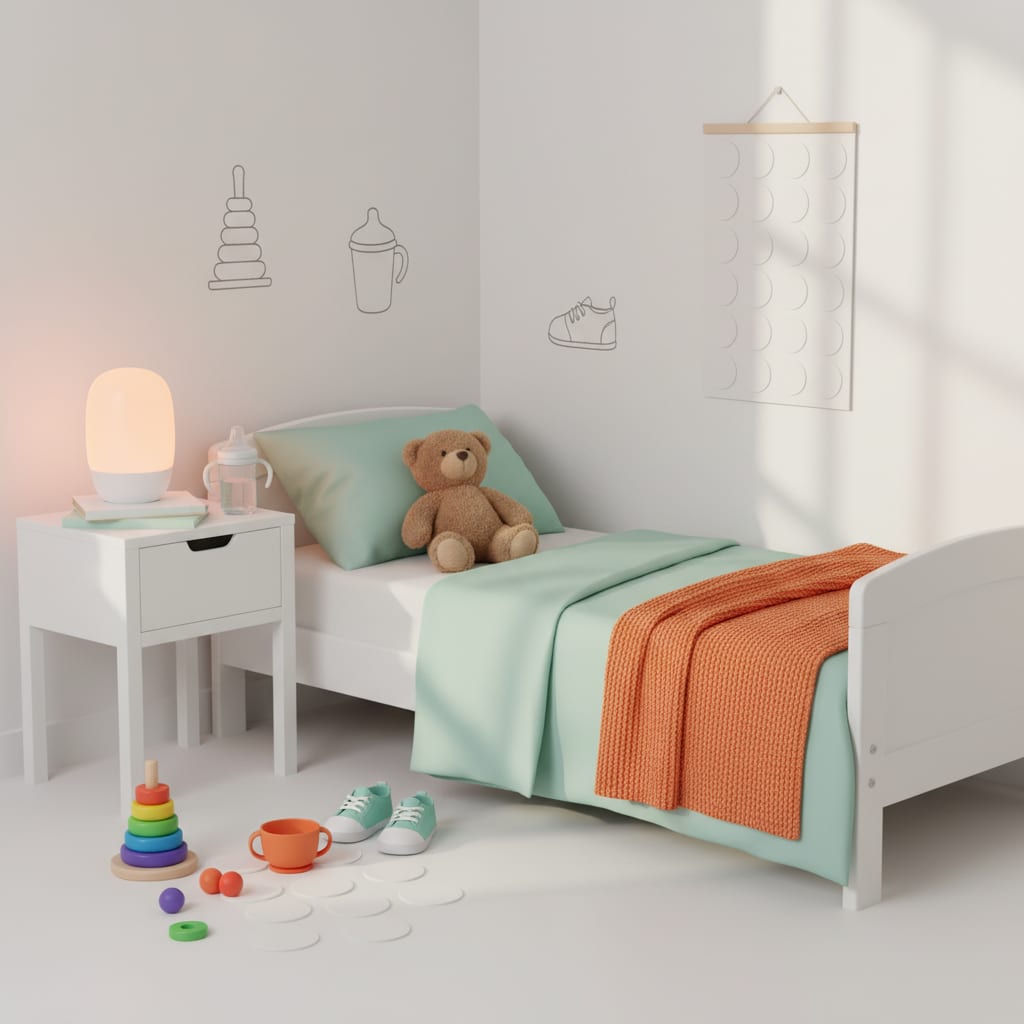
- Take the mattress as low as it goes. A convertible toddler bed usually has a lowest setting, so use it. If it won’t go lower, the mattress straight on the floor is a perfectly good answer while you sort out the rest. If you keep it that way, Betteroo’s guide to running a floor bed safely is blunt about the catch: the whole room becomes the sleep space and has to be childproofed to match.
- Pad the landing side. A thick rug, a folded blanket or a foam play mat along the open side. Then get down at floor level and look for what a falling head could meet: the corner of a nightstand, a toy bin, a radiator. Move those, not the toddler.
- Give the bed one open side, not two. Push it into a corner so two sides are against walls, and push it hard. A gap between mattress and wall that a small body could slide into is a worse problem than the fall you’re fixing. If the room won’t let you close that gap, leave the bed off the wall and use a rail on both sides.
- Keep the bed away from the window. The AAP’s bedroom safety page says not to place a crib “or any other child’s bed” near a window, both to prevent the worst falls and to keep children away from blind cords. My yes space bedroom covers the rest of the room once there’s no crib to contain them.
Choosing and fitting a rail (5–9)
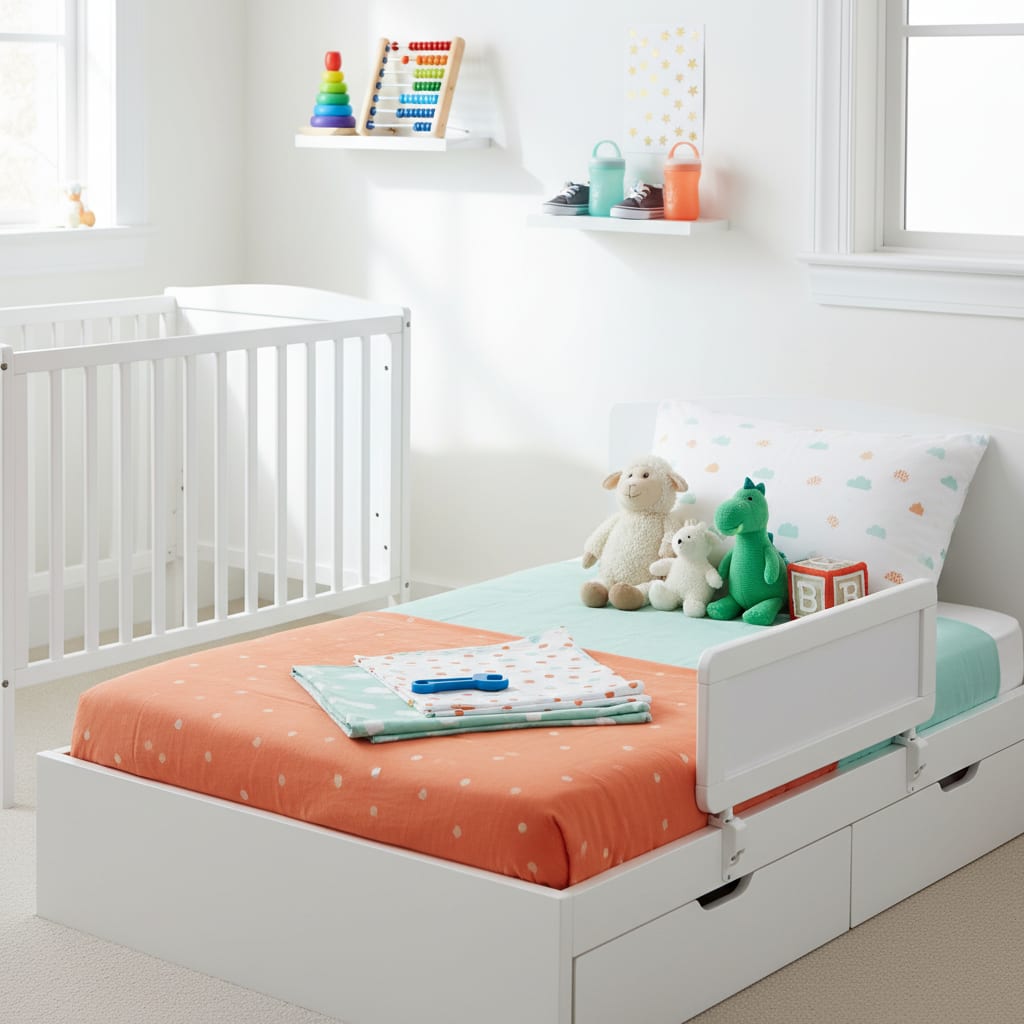
- Match the rail to the bed and the age. Most toddler beds come with short built-in side guards, so use them. For a twin or bigger bed, the CPSC says portable bed rails are for children “typically age 2 to 5 years old” and “should never be used with children younger than two years old.” So an under-two in a big bed needs a lower mattress or the crib, not a rail.
- Check for a gap every night, not just on day one. The CPSC is plain about why: “Gaps in and around bed rails have entrapped young children and killed infants.” Press the mattress away from the rail with your hand. If you can open a space, the rail is loose or the mattress has slid, so refit it before bedtime.
- Install it exactly as the instructions say. The CPSC’s standard targets “consumer assembly and installation problems that have resulted in child deaths,” which is why the anchors or straps have to be permanently attached to the rail. Use every strap and recheck them after the first week. As a worked example, the Regalo Swing Down bed rail fits twin, full and queen beds and swings down at story time.
- Skip the cheapest no-name rail. Since October 2025 the CPSC has told parents to stop using more than one brand of children’s bed rail sold online. Its April 2026 warning said the rails failed the standard’s “structural integrity, openings, and hardware requirements,” posing “a deadly entrapment hazard.” Check a rail against cpsc.gov recalls before you buy it, and especially before you take one second-hand.
- Remember what a rail is for. A rail catches a sleeping toddler who rolls. It doesn’t stop an awake one who climbs, and a toddler going over the top of a rail is falling from higher than the mattress would have dropped them. If the “falls” happen while they’re awake, that’s a climbing problem. Go back to tip 1, and the crib climber tips cover keeping a determined climber contained.
After a fall: what to check (10–13)
- Comfort first, then look. Pick them up, calm them, then check their head for a lump, a cut or a dent. The AAP says a child who is alert and responds to you after a bump usually has a mild injury, and the crying from pain or fright “should last no longer than 10 minutes.” A cold pack wrapped in a cloth for 20 minutes helps the swelling. A big lump on its own isn’t the alarm: Seattle Children’s says “swelling of the scalp does not mean there is any swelling of the brain.”
- Know the call-911 signs. The AAP says to call 911 if your child loses consciousness. Seattle Children’s adds a seizure, being hard to wake, confused or slurred talking, and walking that isn’t steady or arms and legs that seem weak.
- Know the go-to-the-ER signs. The AAP’s page on toddlers who hit their head says to go to the emergency department right away for repeated vomiting, slurred speech, looking very drowsy or not waking, one pupil larger than the other, a seizure, or not acting like their usual self. Seattle Children’s says to call the doctor or get care now for swelling larger than 1 inch, a cut that may need stitches, or bleeding that won’t stop after 10 minutes of pressure. And the AAP’s general rule is simple: for anything more than a light bump on the head, call your child’s doctor. Its general head-injury page is written for children 2 and older, so with a child under 2, lean toward that call.
- Keep them close for the rest of the night. It’s fine to let them go back to sleep. The AAP says so, and the NHS says children “do not need to stay awake” if they’re tired. Your doctor may suggest checking on them every 2 to 3 hours. Seattle Children’s suggests sleeping in the same room for that first night. Over the next day, call the doctor if they vomit more than 2 or 3 times, become harder to wake, or have trouble walking, talking or seeing. The AAP adds that in little ones the signs can show up as behavior changes in the days that follow: crankier, clingier, sleeping or eating differently.

FAQ: toddler falling out of bed
Is it normal for a toddler to fall out of bed?
Common, especially in the first weeks without crib sides. A fall now and then from a low bed is usually a scare rather than an injury. Falls every night mean the setup needs changing: lower mattress, flush rail, padded floor.
Does my toddler need a bed rail?
On a low toddler bed, the built-in side guards are often enough. On a twin or bigger bed, a rail makes sense for a roller aged 2 or over, never younger. Whatever you use, it must sit flush against the mattress with no gap.
Can my toddler sleep after falling out of bed and hitting their head?
Yes, if they’re acting normally. The AAP says it’s okay for a child to go to sleep after a head injury, and your doctor may suggest checking them every 2 to 3 hours. If they’re hard to wake, vomit repeatedly or seem confused, get medical help straight away.
Should I move them back to the crib?
Only if it still fits them. The AAP says to move a child out of the crib once they’re 35 inches tall, or once the crib side is less than three-quarters of their height. If they’re under both lines and not climbing, the crib is still a safe option, and Betteroo’s toddler-bed piece argues for waiting until closer to three anyway. If they’ve outgrown it, lower the bed instead.