Toddler Opens the Stair Gate at Night? 10 Safety Fixes
The night a toddler works out the gate latch, you don’t have a sleep problem yet — you have a stairs problem. Treat the gate as gone: put a gate they genuinely cannot operate at the top of the stairs, move your containment line to their bedroom doorway, and make the room survivable for a kid who’s loose in it at 2am. Only then go back to the business of keeping them in bed. Ten fixes in that order, tested on my own two.
Why the order matters
A gate a two-year-old can open is worse than no gate, because you’re still sleeping as though it’s working. Everything below assumes they will be standing at the top of your staircase this week, and that you won’t hear it happen.
The stairs come first (tips 1–3)
-
Put a hardware-mounted gate at the top, not a pressure-fit one. The AAP’s home safety guidance says to install gates at both the top and bottom of stairs, to avoid accordion-style versions that can trap an arm or a neck, and to use gates “firmly mounted to the home’s studs.” That last phrase is the one that matters — a gate wedged in by tension is the sort a determined toddler shifts, and at the top of a staircase there’s no margin for it giving way. The Cardinal Gates Stairway Special is the one I ended up with: it mounts at an angle if your newel post is awkward, and the latch takes one adult hand and no toddler hands.
-
Gate the bottom as well, and do it this week. Everyone gates the top and forgets the bottom, which is where a child already loose on the ground floor goes next — and the AAP names both ends. A pressure-fit gate is fine down there.
-
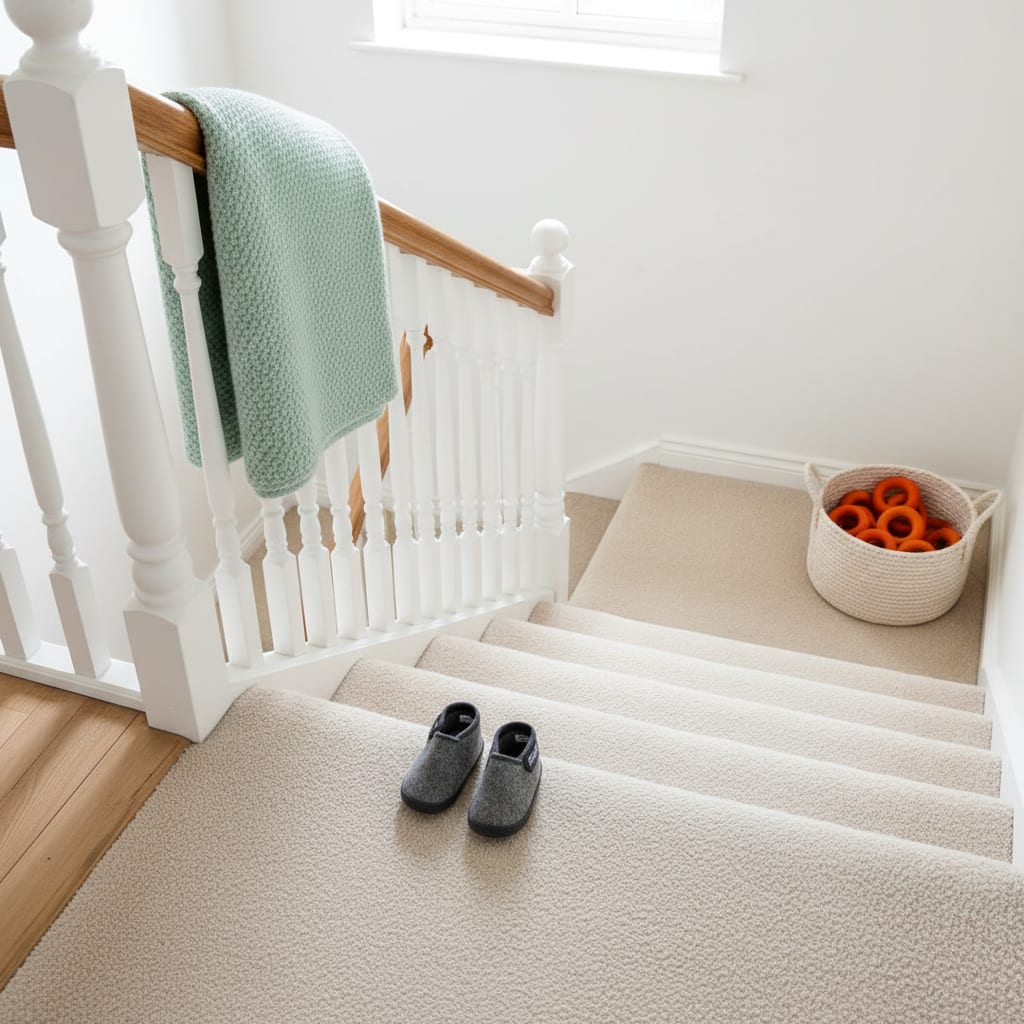
Make the treads slippery-proof, then deal with socks. Carpeted stairs help, and the same guidance is specific that the carpet must be “firmly tacked down at the edges.” It also flags children running on hard floors in socks — precisely the outfit a toddler is wearing at 2am. Bare feet or grippy-soled slippers, and the socks go in the wash basket at bath time.
Move the line to their doorway (tips 4–5)
-
Put the gate they can’t work at their bedroom door instead of the landing. This is the fix that changed our nights. One gate at their own doorway does the work of three around the house: they’re contained where you can hear them, the stairs are two barriers away rather than one, and they can still call down the hall so the room doesn’t feel like a cell. Set it at bath time, so it’s routine rather than a punishment that appeared after a bad night.
-
Lock the dangerous doors, not theirs. The AAP’s 1-to-2-year safety page is blunt about it: “to prevent serious falls, lock the doors to any dangerous areas.” That means basement stairs, the garage, the laundry, the bathroom. It does not mean their own bedroom door: a door that can’t be opened from the inside is a barrier for you as well as them, and a gate does the same containment job while leaving the exit open.
Make the room survivable (tips 6–7)
-
Anchor everything in there, and use metal. The AAP’s tip-over prevention page says to “secure all furniture and mirrors with anti-tip devices,” notes this “may require relocating the furniture so the wall anchors can be placed in a stud,” and specifically recommends metal brackets over plastic ones, which go brittle. It also says roughly half of tip-over incidents happen in bedrooms — the room your child is now awake and unsupervised in. Heavy things in the bottom drawers, drawer stops fitted, and never a TV on a dresser. An all-metal anti-tip strap kit covers a dresser and a bookcase in an evening.
-
Windows, cords, and whatever is standing under them. Operable window guards above the first floor, per the same AAP page. On blinds, the home safety guidance says to go cordless where you can, and otherwise to anchor cords taut to floor mounts or wrap them around wall brackets out of reach. Then look at what’s beneath the window, because the AAP’s line here is the one every parent of a climber recognises: “a chair left next to a kitchen counter, table, or window allows your child to climb to dangerously high places.” A toy box under a window is a step.
Then go back to the sleep (tips 8–10)
-
Work out whether they’re actually awake. A child found on the landing with open eyes, a blank face and no memory of it in the morning wasn’t making a decision — that’s a confusional waking, and it needs containment rather than consequences. Betteroo’s guide on wakings where they look awake but aren’t covers how to tell. If that’s what’s happening, don’t wake them, don’t discuss it the next day, and take tips 1 to 3 twice as seriously — a child in that state genuinely does not see the top step.
-
Rebuild the alarm you just lost. You used to hear the gate. Now you hear nothing, and that’s the actual risk. Point the monitor at the doorway rather than the bed, or wedge their door at a fixed width so any movement of it makes a noise you’ll recognise. Ours was a floorboard outside the room, and once I knew which one it was I stopped sleeping through the exit.
-
Now do the boring return-to-bed work. With the house safe, this becomes an ordinary problem again: walk them back, say almost nothing, repeat. My tricks for the toddler who won’t stay in bed is the full script, and if they’re ending up in your room instead of on the landing, sending them back kindly is the gentler version. Some families take the opposite route and remove the climbing problem altogether — a floor-level setup in a fully secured room, which Betteroo’s floor-bed rundown walks through room by room.
Where this usually comes from
Gate-opening usually arrives in the same month as another escape skill. If they got out of the cot first, my crib climber fixes is the earlier stage of the same story; if the gate went right after the big-kid bed appeared, the smooth-switch tips cover the fortnight of testing that follows. It passes — and the safety work you do this week is what makes it a phase rather than an incident.
Worth a word with your pediatrician if the night wandering is frequent and they’re genuinely not awake for it, if it comes with breathing that sounds laboured or very loud snoring, or if a child who slept well for months starts roaming every night with no other change.

FAQ: the toddler who can open the gate
At what age can toddlers open safety gates?
There’s no fixed age — it depends far more on the latch than the child. Plenty of two-year-olds work a simple foot-pedal or squeeze catch. Assume a gate is openable the first time you find it swinging, rather than waiting for a second demonstration.
Should I lock my toddler in their bedroom at night?
No. A door that can’t be opened from the inside is a barrier in an emergency too, and it removes your ability to hear what’s happening. A gate at the doorway gives you the same containment while the doorway stays open.
Is a pressure-mounted gate safe at the top of the stairs?
Not as your barrier there. The AAP’s wording is that gates should be firmly mounted to the home’s studs, and a tension-fit gate at the top of a staircase relies on friction that a leaning toddler can defeat. Keep pressure gates for doorways and the bottom of the stairs.
My toddler climbs over the gate instead of opening it. Same fixes?
Mostly, yes — the containment has failed either way, so tips 1 to 7 apply unchanged. What changes is that a taller gate rarely helps a climber, and the gate itself becomes something to fall from. Move the barrier to the bedroom doorway and put the effort into the room.
Do I need the gate once they can climb stairs safely?
Climbing up competently and coming down safely half asleep are different skills, and the second arrives much later. Keep the top gate long past the point it feels necessary in daylight — the risk you’re covering is the 2am trip, not the afternoon one.